


Yesterday, I released a new episode of The Screenagers Podcast titled From Junk Food to Social Media: How Teens Get Manipulated.
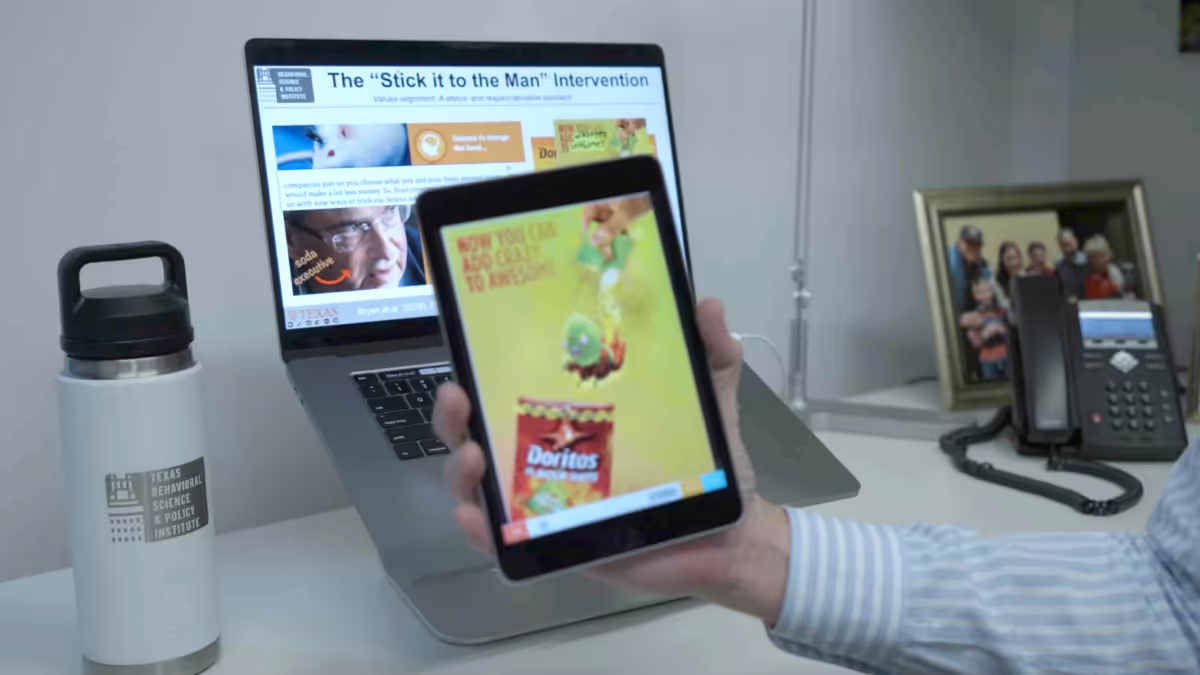
In it, David Yeager, PhD, a psychology professor at the University of Texas at Austin and a well-regarded scientist in mindsets and motivations trained under the pioneer of Growth Mindset theory, Carol Dweck, discusses a recent study that examines how youth’s desire to use social media is impacted when they learn how companies are explicitly trying to manipulate them.
This is an excerpt from the episode where Yeager shares one of his groundbreaking studies, in which kids chose to eat 30% fewer sugary foods in school cafeterias during lunch because of the intervention they did. What’s really interesting is that this 30% drop lasted for several months after the intervention!
David’s interventional studies focus on harnessing children's and teens' values, such as wanting autonomy and caring about social justice, to help them make healthier and wiser choices in their lives.
David says,
“A lot of people think teenagers are like in one ear out the other, but that's not what we think. If you change what someone believes about a company, that sticks with them. You don't really need to be reminded of that, especially if it's egregious or hypocritical or harmful.”


Learn more about showing our movies in your school or community!
Join Screenagers filmmaker Delaney Ruston MD for our latest Podcast

Learn more about our Screen-Free Sleep campaign at the website!
Our movie made for parents and educators of younger kids
Learn more about showing our movies in your school or community!
Register your interest in bringing our new movie to your school or community
So what about influencing the mindsets of youth regarding social media by looking at some of the negative issues associated with some companies?
Here is the section of the podcast in which David discusses Brian Galla’s work on this topic.
“Yeah, so some new research is really promising. It's applying this idea of values alignment, of aligning healthy behavior with Values like autonomy and concern for social justice, to the social media context. So in a way that's very similar to the tobacco companies’ market to children and how food companies make hot Cheetos addictive to children.
Social media companies have also marketed their products to children and made them have this neural reward that is very addictive. In a promising study led by Brian Gala, they've looked at whether you can make this same kind of argument. about the social media companies.
Brian Gallo and his colleagues ran an experiment where there were two groups. In one group, they got an exposé about the practices of the social media companies that cause young people to continue to want to revisit and scroll through every day, to grab their eyeballs for attention to make money. In another group, they got neutral content that did not inform young people of social media.
Then, they compared the social media use of those two groups over time. What types of things were students told about the way social media platforms are designed? It's designed to make you feel like you're It's never enough. You don't measure up. And also that you're going to miss out on your whole social life if you're not constantly checking up.
And that's exploiting everything that we've learned about the adolescent brain and how it processes reward and so on. Those design principles cause the applications to be addictive. And when you tell teenagers about that, they say, ‘That actually seems right to me.’ And they really respond negatively.
They say, “This is not how I want to spend my time. This is not how I want to be.”
After young people read the exposé about the social media companies’ practices they were more motivated to put down their social media and to use it less. Three months later, they had different attitudes about social media and they were more aware of these manipulative practices in the applications."
This podcast episode is a fantastic one to listen to with the youth in your life, or you can recommend that they listen to it on their own.
Learn more about showing our movies in your school or community!
Join Screenagers filmmaker Delaney Ruston MD for our latest Podcast
Learn more about our Screen-Free Sleep campaign at the website!
Our movie made for parents and educators of younger kids
Join Screenagers filmmaker Delaney Ruston MD for our latest Podcast
Register your interest in bringing our new movie to your school or community
Be sure to subscribe to our YouTube Channel! With new ones added regularly, you'll find over 100 videos covering parenting advice, guidance, podcasts, movie clips and more. Here's our latest!

As we’re about to celebrate 10 years of Screenagers, we want to hear what’s been most helpful and what you’d like to see next.
Please click here to share your thoughts with us in our community survey. It only takes 5–10 minutes, and everyone who completes it will be entered to win one of five $50 Amazon vouchers.
Yesterday, I released a new episode of The Screenagers Podcast titled From Junk Food to Social Media: How Teens Get Manipulated.
In it, David Yeager, PhD, a psychology professor at the University of Texas at Austin and a well-regarded scientist in mindsets and motivations trained under the pioneer of Growth Mindset theory, Carol Dweck, discusses a recent study that examines how youth’s desire to use social media is impacted when they learn how companies are explicitly trying to manipulate them.
This is an excerpt from the episode where Yeager shares one of his groundbreaking studies, in which kids chose to eat 30% fewer sugary foods in school cafeterias during lunch because of the intervention they did. What’s really interesting is that this 30% drop lasted for several months after the intervention!
David’s interventional studies focus on harnessing children's and teens' values, such as wanting autonomy and caring about social justice, to help them make healthier and wiser choices in their lives.
David says,
“A lot of people think teenagers are like in one ear out the other, but that's not what we think. If you change what someone believes about a company, that sticks with them. You don't really need to be reminded of that, especially if it's egregious or hypocritical or harmful.”
So what about influencing the mindsets of youth regarding social media by looking at some of the negative issues associated with some companies?
Here is the section of the podcast in which David discusses Brian Galla’s work on this topic.
“Yeah, so some new research is really promising. It's applying this idea of values alignment, of aligning healthy behavior with Values like autonomy and concern for social justice, to the social media context. So in a way that's very similar to the tobacco companies’ market to children and how food companies make hot Cheetos addictive to children.
Social media companies have also marketed their products to children and made them have this neural reward that is very addictive. In a promising study led by Brian Gala, they've looked at whether you can make this same kind of argument. about the social media companies.
Brian Gallo and his colleagues ran an experiment where there were two groups. In one group, they got an exposé about the practices of the social media companies that cause young people to continue to want to revisit and scroll through every day, to grab their eyeballs for attention to make money. In another group, they got neutral content that did not inform young people of social media.
Then, they compared the social media use of those two groups over time. What types of things were students told about the way social media platforms are designed? It's designed to make you feel like you're It's never enough. You don't measure up. And also that you're going to miss out on your whole social life if you're not constantly checking up.
And that's exploiting everything that we've learned about the adolescent brain and how it processes reward and so on. Those design principles cause the applications to be addictive. And when you tell teenagers about that, they say, ‘That actually seems right to me.’ And they really respond negatively.
They say, “This is not how I want to spend my time. This is not how I want to be.”
After young people read the exposé about the social media companies’ practices they were more motivated to put down their social media and to use it less. Three months later, they had different attitudes about social media and they were more aware of these manipulative practices in the applications."
This podcast episode is a fantastic one to listen to with the youth in your life, or you can recommend that they listen to it on their own.
Be sure to subscribe to our YouTube Channel! With new ones added regularly, you'll find over 100 videos covering parenting advice, guidance, podcasts, movie clips and more. Here's our latest!
Sign up here to receive the weekly Tech Talk Tuesdays newsletter from Screenagers filmmaker Delaney Ruston MD.
We respect your privacy.
Yesterday, I released a new episode of The Screenagers Podcast titled From Junk Food to Social Media: How Teens Get Manipulated.
In it, David Yeager, PhD, a psychology professor at the University of Texas at Austin and a well-regarded scientist in mindsets and motivations trained under the pioneer of Growth Mindset theory, Carol Dweck, discusses a recent study that examines how youth’s desire to use social media is impacted when they learn how companies are explicitly trying to manipulate them.
This is an excerpt from the episode where Yeager shares one of his groundbreaking studies, in which kids chose to eat 30% fewer sugary foods in school cafeterias during lunch because of the intervention they did. What’s really interesting is that this 30% drop lasted for several months after the intervention!
David’s interventional studies focus on harnessing children's and teens' values, such as wanting autonomy and caring about social justice, to help them make healthier and wiser choices in their lives.
David says,
“A lot of people think teenagers are like in one ear out the other, but that's not what we think. If you change what someone believes about a company, that sticks with them. You don't really need to be reminded of that, especially if it's egregious or hypocritical or harmful.”

I've been noticing the ways I can be rude, in person and on my phone. This week I share two recent examples of my own, plus why correcting myself out loud strengthens self-awareness. The talk that follows isn't about your kid. It's about you going first.
READ MORE >
An Oakland library has started lending out sports equipment and games alongside books, so families can borrow gear to use at nearby parks. It is a reminder that borrowing and lending between families is a simple way to fill a summer afternoon without a screen, while quietly modelling generosity and humility. We are out of practice at asking, but the person on the other end is usually glad to help.
READ MORE >
E-readers are convenient, but there are three reasons to lean toward paper books this summer. First, e-readers are screens, and the pull of everything else you could do on one makes it harder to stay immersed. Second, a large meta-analysis found people understand and remember slightly better on paper, especially with longer texts. Third, easy access to endless book samples makes it too tempting to jump ship rather than work through the slower parts, since reading, unlike TikTok, is about delayed gratification.
READ MORE >for more like this, DR. DELANEY RUSTON'S NEW BOOK, PARENTING IN THE SCREEN AGE, IS THE DEFINITIVE GUIDE FOR TODAY’S PARENTS. WITH INSIGHTS ON SCREEN TIME FROM RESEARCHERS, INPUT FROM KIDS & TEENS, THIS BOOK IS PACKED WITH SOLUTIONS FOR HOW TO START AND SUSTAIN PRODUCTIVE FAMILY TALKS ABOUT TECHNOLOGY AND IT’S IMPACT ON OUR MENTAL WELLBEING.