

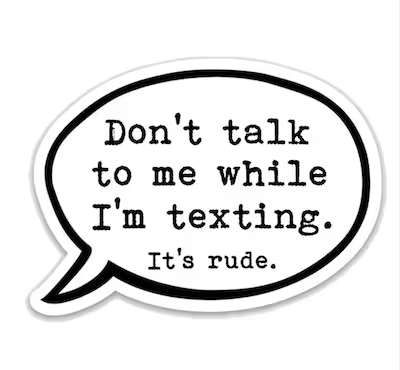

When I saw this sticker in a bookstore, it made me laugh. I asked myself, “Is this what it has all come to?” Fortunately, I know that it is being tongue-in-cheek.
Then I remembered that people can get unexpectedly irritated when texting, and someone chimes in — like my husband.
If he is composing a text via “talk-to-text,” and I don’t realize that is what he is doing, and I say something, he gets that “I’m super annoyed” look in his eyes.
Fact: humans can become highly irritated by what seems like minor things for some inexplicable reason. Our wired world provides many such situations.
The things I am talking about are those things that reflexively erk us deeply, but if we try to explain logically why, we get tongue-tied. (Versus scenarios in our home of excessive screen time, and we can easily put into words why our anxiety rises — sleep loss, physical and mental health, etc.)
I would wager a hefty sum of money that everyone reading this experiences levels of annoyance by things people do tech-wise that feel out of proportion to the actual act.
What better time to talk about these things with family members (or in a classroom) than during a calm, tech talk? Today I offer several personal examples from my family and others and four ways to address these dilemmas.
Here is something that surprised me the other day. I was reading some texts, and my husband started looking over my shoulder and reading them. No biggie, nothing to hide; why should I care?
I was stunned by how mentally AND physiologically annoyed I became. It was a big ah-ha moment. Long ago, I learned not to do this with my kids because of their intense reactions. Let's say they were scrolling through Instagram, and I gently leaned over and said, “What are you looking at?” They would go from a calm demeanor to a cat ready to pounce.
I quickly learned to ask if I could see, or if they could at least tell me, what they were looking or laughing at. And if they said no, I would not get frustrated with them.
It was this day with my husband that I viscerally could relate to their annoyance. Talking with many people, I hear the same unexplainably intense emotion when our tech space “bubble” is violated.
(To be clear, this does not mean I never looked at their social media. To the contrary, all along, my husband and I have had periodic checks whereby our kids show us some of their feeds as a way to talk about what’s happening in their online in their lives.)


Learn more about showing our movies in your school or community!
Join Screenagers filmmaker Delaney Ruston MD for our latest Podcast

Learn more about our Screen-Free Sleep campaign at the website!
Our movie made for parents and educators of younger kids
Learn more about showing our movies in your school or community!
Register your interest in bringing our new movie to your school or community
Another thing that drives my husband batty is if he is chatting on speaker phone with someone I know, say his father or a mutual friend, and I chime in. I have stopped doing that since it bugs him so much.
I have heard from others, including Lisa Tabb, who co-directed Screenagers Under The Influence with me. She gets super annoyed when her husband, Sam, asks Siri a question over-and-over until it comes up with the answer, rather than just typing it into his phone.
Sam will say something like, “Siri, is Lake Lagunitas stocked for fishing.” And Siri will say, “I’m sorry, I don’t understand the question.” Then, he’ll try to say it differently, which can go on 4-5 times. Lisa is irritated because she has to hear him ask Siri over and over when he could have just typed the question.
Sam says he gets irritated when Lisa forgets to put her phone on silent at night because he can still hear notifications go off even though she keeps the phone out of the bedroom.
Sam also has a serious pet peeve when he and Lisa are driving, and they have two different map apps running simultaneously on each of their phones, and the apps start giving opposing directions.
Another mom told me her blood pressure shoots up when talking with her teens, and they keep peeking down at their phones or laptops while she is talking. Oh, so relatable!
Learn more about showing our movies in your school or community!
Join Screenagers filmmaker Delaney Ruston MD for our latest Podcast
Learn more about our Screen-Free Sleep campaign at the website!
Our movie made for parents and educators of younger kids
Join Screenagers filmmaker Delaney Ruston MD for our latest Podcast
Register your interest in bringing our new movie to your school or community
I spend a lot of time telling my teen patients that emotions just happen. We don’t want to feel these feelings — they just come upon us. It is key that youth don’t blame themselves for the emotions that happen to them.
In the same way, my husband does not want to feel irritated when I chime into a conversation, but he does. I could argue against his feelings, but he “has a right to his emotions.” That is a great line that Laura Kastner, Ph.D., says in our latest film, Screenagers Under The Influence.
If I try to reason with my husband to explain why he should not have the emotion when I do this action, how helpful will that be in stopping his emotion? Not.
Taking this example of my chiming in when my husband is on speaker phone, I decided to respond by working not to do this. I give myself silent brownie points whenever I want to chime in, but I hold back. Instead, I might signal in the air to him to let me talk with the person when he is done, or I make a mental note to reach out to that person another time.
We often assume people know how frustrated we feel, yet they don’t. Mention that you know it defies logic but want them to know your mental and physical reaction level. You wish it did not happen, but it does.
The mom whose teens keep glancing at their phones or computers has been talking about this issue, and she has asked her kids to close their lids or turn over their phones when she is talking to them. She told me they are getting into the habit of doing this slowly and with setbacks, but it is happening.

As we’re about to celebrate 10 years of Screenagers, we want to hear what’s been most helpful and what you’d like to see next.
Please click here to share your thoughts with us in our community survey. It only takes 5–10 minutes, and everyone who completes it will be entered to win one of five $50 Amazon vouchers.
When I saw this sticker in a bookstore, it made me laugh. I asked myself, “Is this what it has all come to?” Fortunately, I know that it is being tongue-in-cheek.
Then I remembered that people can get unexpectedly irritated when texting, and someone chimes in — like my husband.
If he is composing a text via “talk-to-text,” and I don’t realize that is what he is doing, and I say something, he gets that “I’m super annoyed” look in his eyes.
Fact: humans can become highly irritated by what seems like minor things for some inexplicable reason. Our wired world provides many such situations.
The things I am talking about are those things that reflexively erk us deeply, but if we try to explain logically why, we get tongue-tied. (Versus scenarios in our home of excessive screen time, and we can easily put into words why our anxiety rises — sleep loss, physical and mental health, etc.)
I would wager a hefty sum of money that everyone reading this experiences levels of annoyance by things people do tech-wise that feel out of proportion to the actual act.
What better time to talk about these things with family members (or in a classroom) than during a calm, tech talk? Today I offer several personal examples from my family and others and four ways to address these dilemmas.
Here is something that surprised me the other day. I was reading some texts, and my husband started looking over my shoulder and reading them. No biggie, nothing to hide; why should I care?
I was stunned by how mentally AND physiologically annoyed I became. It was a big ah-ha moment. Long ago, I learned not to do this with my kids because of their intense reactions. Let's say they were scrolling through Instagram, and I gently leaned over and said, “What are you looking at?” They would go from a calm demeanor to a cat ready to pounce.
I quickly learned to ask if I could see, or if they could at least tell me, what they were looking or laughing at. And if they said no, I would not get frustrated with them.
It was this day with my husband that I viscerally could relate to their annoyance. Talking with many people, I hear the same unexplainably intense emotion when our tech space “bubble” is violated.
(To be clear, this does not mean I never looked at their social media. To the contrary, all along, my husband and I have had periodic checks whereby our kids show us some of their feeds as a way to talk about what’s happening in their online in their lives.)
Another thing that drives my husband batty is if he is chatting on speaker phone with someone I know, say his father or a mutual friend, and I chime in. I have stopped doing that since it bugs him so much.
I have heard from others, including Lisa Tabb, who co-directed Screenagers Under The Influence with me. She gets super annoyed when her husband, Sam, asks Siri a question over-and-over until it comes up with the answer, rather than just typing it into his phone.
Sam will say something like, “Siri, is Lake Lagunitas stocked for fishing.” And Siri will say, “I’m sorry, I don’t understand the question.” Then, he’ll try to say it differently, which can go on 4-5 times. Lisa is irritated because she has to hear him ask Siri over and over when he could have just typed the question.
Sam says he gets irritated when Lisa forgets to put her phone on silent at night because he can still hear notifications go off even though she keeps the phone out of the bedroom.
Sam also has a serious pet peeve when he and Lisa are driving, and they have two different map apps running simultaneously on each of their phones, and the apps start giving opposing directions.
Another mom told me her blood pressure shoots up when talking with her teens, and they keep peeking down at their phones or laptops while she is talking. Oh, so relatable!
I spend a lot of time telling my teen patients that emotions just happen. We don’t want to feel these feelings — they just come upon us. It is key that youth don’t blame themselves for the emotions that happen to them.
In the same way, my husband does not want to feel irritated when I chime into a conversation, but he does. I could argue against his feelings, but he “has a right to his emotions.” That is a great line that Laura Kastner, Ph.D., says in our latest film, Screenagers Under The Influence.
If I try to reason with my husband to explain why he should not have the emotion when I do this action, how helpful will that be in stopping his emotion? Not.
Taking this example of my chiming in when my husband is on speaker phone, I decided to respond by working not to do this. I give myself silent brownie points whenever I want to chime in, but I hold back. Instead, I might signal in the air to him to let me talk with the person when he is done, or I make a mental note to reach out to that person another time.
We often assume people know how frustrated we feel, yet they don’t. Mention that you know it defies logic but want them to know your mental and physical reaction level. You wish it did not happen, but it does.
The mom whose teens keep glancing at their phones or computers has been talking about this issue, and she has asked her kids to close their lids or turn over their phones when she is talking to them. She told me they are getting into the habit of doing this slowly and with setbacks, but it is happening.
Sign up here to receive the weekly Tech Talk Tuesdays newsletter from Screenagers filmmaker Delaney Ruston MD.
We respect your privacy.
When I saw this sticker in a bookstore, it made me laugh. I asked myself, “Is this what it has all come to?” Fortunately, I know that it is being tongue-in-cheek.
Then I remembered that people can get unexpectedly irritated when texting, and someone chimes in — like my husband.
If he is composing a text via “talk-to-text,” and I don’t realize that is what he is doing, and I say something, he gets that “I’m super annoyed” look in his eyes.
Fact: humans can become highly irritated by what seems like minor things for some inexplicable reason. Our wired world provides many such situations.
The things I am talking about are those things that reflexively erk us deeply, but if we try to explain logically why, we get tongue-tied. (Versus scenarios in our home of excessive screen time, and we can easily put into words why our anxiety rises — sleep loss, physical and mental health, etc.)
I would wager a hefty sum of money that everyone reading this experiences levels of annoyance by things people do tech-wise that feel out of proportion to the actual act.
What better time to talk about these things with family members (or in a classroom) than during a calm, tech talk? Today I offer several personal examples from my family and others and four ways to address these dilemmas.
Here is something that surprised me the other day. I was reading some texts, and my husband started looking over my shoulder and reading them. No biggie, nothing to hide; why should I care?
I was stunned by how mentally AND physiologically annoyed I became. It was a big ah-ha moment. Long ago, I learned not to do this with my kids because of their intense reactions. Let's say they were scrolling through Instagram, and I gently leaned over and said, “What are you looking at?” They would go from a calm demeanor to a cat ready to pounce.
I quickly learned to ask if I could see, or if they could at least tell me, what they were looking or laughing at. And if they said no, I would not get frustrated with them.
It was this day with my husband that I viscerally could relate to their annoyance. Talking with many people, I hear the same unexplainably intense emotion when our tech space “bubble” is violated.
(To be clear, this does not mean I never looked at their social media. To the contrary, all along, my husband and I have had periodic checks whereby our kids show us some of their feeds as a way to talk about what’s happening in their online in their lives.)
I've been noticing the ways I can be rude, in person and on my phone. This week I share two recent examples of my own, plus why correcting myself out loud strengthens self-awareness. The talk that follows isn't about your kid. It's about you going first.
READ MORE >
An Oakland library has started lending out sports equipment and games alongside books, so families can borrow gear to use at nearby parks. It is a reminder that borrowing and lending between families is a simple way to fill a summer afternoon without a screen, while quietly modelling generosity and humility. We are out of practice at asking, but the person on the other end is usually glad to help.
READ MORE >
E-readers are convenient, but there are three reasons to lean toward paper books this summer. First, e-readers are screens, and the pull of everything else you could do on one makes it harder to stay immersed. Second, a large meta-analysis found people understand and remember slightly better on paper, especially with longer texts. Third, easy access to endless book samples makes it too tempting to jump ship rather than work through the slower parts, since reading, unlike TikTok, is about delayed gratification.
READ MORE >for more like this, DR. DELANEY RUSTON'S NEW BOOK, PARENTING IN THE SCREEN AGE, IS THE DEFINITIVE GUIDE FOR TODAY’S PARENTS. WITH INSIGHTS ON SCREEN TIME FROM RESEARCHERS, INPUT FROM KIDS & TEENS, THIS BOOK IS PACKED WITH SOLUTIONS FOR HOW TO START AND SUSTAIN PRODUCTIVE FAMILY TALKS ABOUT TECHNOLOGY AND IT’S IMPACT ON OUR MENTAL WELLBEING.