


Last week Good Morning America ran a powerful story about the intense pull of screens and why having and enforcing, limits are so important ... and hard. If there is any way you can make the time to watch the 3-minute video with your kids, teens or students—you will be so glad you did.
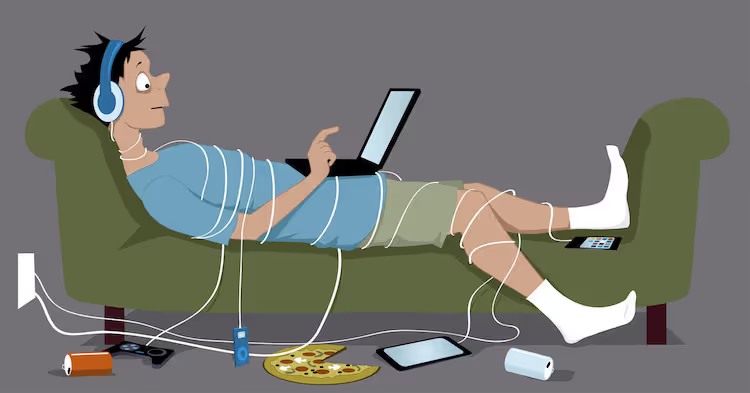
The video shows what happens when a couple allows their four children ages 6 to 11 to have as much screen time as they want for 48 hours. The kids often used more than one screen at the same time, and the producers counted all screens used when calculating times—so 3 hours with two screens going would be counted as 6 hours. The total time on screens for each of the kids came to 16, 29, 35 and 46 hours over the course of the two days. On Sunday night when the experiment finished, and the parents took their devices away, the kids had major meltdowns.
Knowing which rules, limits, and guidelines to have can be confusing for parents, and then comes the work of implementing them consistently which can be exhausting. While filming Screenagers, I learned how reticent parents are to share their screen time rules. The fear of being judged as “lazy and too lax” or “overly controlling” prevents many of us from telling others the rules we are trying (I count having no rules as a type of rule setting).
The reporter for the Good Morning America story, Becky Worley, wrote an accompanying blog to her segment in which she reveals her own family rules:
“I have been covering and studying this issue (tech) for a long time. As a result, I am super strict with my 10-year-old twins: No screens at all during the week and only TV shows on the big screen on the weekends. No YouTube, no tablet games, no Xbox or PlayStation in our house. My two exceptions are planes and hospitals.”
And to my point, she adds:
“This is the first time I’m writing about what our family does because I don’t want to seem judgmental; there are a million different types of kids, family situations, and techniques for parenting.”
If the video motivated you to rethink the limits in your home, here is a free online tool to help which is put out by American Association of Pediatrics (AAP). If you have rules, but they need a refresh, now could be that time.


Learn more about showing our movies in your school or community!
Join Screenagers filmmaker Delaney Ruston MD for our latest Podcast

Learn more about our Screen-Free Sleep campaign at the website!
Our movie made for parents and educators of younger kids
Learn more about showing our movies in your school or community!
Register your interest in bringing our new movie to your school or community
Learn more about showing our movies in your school or community!
Join Screenagers filmmaker Delaney Ruston MD for our latest Podcast
Learn more about our Screen-Free Sleep campaign at the website!
Our movie made for parents and educators of younger kids
Join Screenagers filmmaker Delaney Ruston MD for our latest Podcast
Register your interest in bringing our new movie to your school or community

As we’re about to celebrate 10 years of Screenagers, we want to hear what’s been most helpful and what you’d like to see next.
Please click here to share your thoughts with us in our community survey. It only takes 5–10 minutes, and everyone who completes it will be entered to win one of five $50 Amazon vouchers.
Last week Good Morning America ran a powerful story about the intense pull of screens and why having and enforcing, limits are so important ... and hard. If there is any way you can make the time to watch the 3-minute video with your kids, teens or students—you will be so glad you did.
The video shows what happens when a couple allows their four children ages 6 to 11 to have as much screen time as they want for 48 hours. The kids often used more than one screen at the same time, and the producers counted all screens used when calculating times—so 3 hours with two screens going would be counted as 6 hours. The total time on screens for each of the kids came to 16, 29, 35 and 46 hours over the course of the two days. On Sunday night when the experiment finished, and the parents took their devices away, the kids had major meltdowns.
Knowing which rules, limits, and guidelines to have can be confusing for parents, and then comes the work of implementing them consistently which can be exhausting. While filming Screenagers, I learned how reticent parents are to share their screen time rules. The fear of being judged as “lazy and too lax” or “overly controlling” prevents many of us from telling others the rules we are trying (I count having no rules as a type of rule setting).
The reporter for the Good Morning America story, Becky Worley, wrote an accompanying blog to her segment in which she reveals her own family rules:
“I have been covering and studying this issue (tech) for a long time. As a result, I am super strict with my 10-year-old twins: No screens at all during the week and only TV shows on the big screen on the weekends. No YouTube, no tablet games, no Xbox or PlayStation in our house. My two exceptions are planes and hospitals.”
And to my point, she adds:
“This is the first time I’m writing about what our family does because I don’t want to seem judgmental; there are a million different types of kids, family situations, and techniques for parenting.”
If the video motivated you to rethink the limits in your home, here is a free online tool to help which is put out by American Association of Pediatrics (AAP). If you have rules, but they need a refresh, now could be that time.
Sign up here to receive the weekly Tech Talk Tuesdays newsletter from Screenagers filmmaker Delaney Ruston MD.
We respect your privacy.
Last week Good Morning America ran a powerful story about the intense pull of screens and why having and enforcing, limits are so important ... and hard. If there is any way you can make the time to watch the 3-minute video with your kids, teens or students—you will be so glad you did.
The video shows what happens when a couple allows their four children ages 6 to 11 to have as much screen time as they want for 48 hours. The kids often used more than one screen at the same time, and the producers counted all screens used when calculating times—so 3 hours with two screens going would be counted as 6 hours. The total time on screens for each of the kids came to 16, 29, 35 and 46 hours over the course of the two days. On Sunday night when the experiment finished, and the parents took their devices away, the kids had major meltdowns.
Knowing which rules, limits, and guidelines to have can be confusing for parents, and then comes the work of implementing them consistently which can be exhausting. While filming Screenagers, I learned how reticent parents are to share their screen time rules. The fear of being judged as “lazy and too lax” or “overly controlling” prevents many of us from telling others the rules we are trying (I count having no rules as a type of rule setting).
The reporter for the Good Morning America story, Becky Worley, wrote an accompanying blog to her segment in which she reveals her own family rules:
“I have been covering and studying this issue (tech) for a long time. As a result, I am super strict with my 10-year-old twins: No screens at all during the week and only TV shows on the big screen on the weekends. No YouTube, no tablet games, no Xbox or PlayStation in our house. My two exceptions are planes and hospitals.”
And to my point, she adds:
“This is the first time I’m writing about what our family does because I don’t want to seem judgmental; there are a million different types of kids, family situations, and techniques for parenting.”
If the video motivated you to rethink the limits in your home, here is a free online tool to help which is put out by American Association of Pediatrics (AAP). If you have rules, but they need a refresh, now could be that time.

I've been noticing the ways I can be rude, in person and on my phone. This week I share two recent examples of my own, plus why correcting myself out loud strengthens self-awareness. The talk that follows isn't about your kid. It's about you going first.
READ MORE >
An Oakland library has started lending out sports equipment and games alongside books, so families can borrow gear to use at nearby parks. It is a reminder that borrowing and lending between families is a simple way to fill a summer afternoon without a screen, while quietly modelling generosity and humility. We are out of practice at asking, but the person on the other end is usually glad to help.
READ MORE >
E-readers are convenient, but there are three reasons to lean toward paper books this summer. First, e-readers are screens, and the pull of everything else you could do on one makes it harder to stay immersed. Second, a large meta-analysis found people understand and remember slightly better on paper, especially with longer texts. Third, easy access to endless book samples makes it too tempting to jump ship rather than work through the slower parts, since reading, unlike TikTok, is about delayed gratification.
READ MORE >for more like this, DR. DELANEY RUSTON'S NEW BOOK, PARENTING IN THE SCREEN AGE, IS THE DEFINITIVE GUIDE FOR TODAY’S PARENTS. WITH INSIGHTS ON SCREEN TIME FROM RESEARCHERS, INPUT FROM KIDS & TEENS, THIS BOOK IS PACKED WITH SOLUTIONS FOR HOW TO START AND SUSTAIN PRODUCTIVE FAMILY TALKS ABOUT TECHNOLOGY AND IT’S IMPACT ON OUR MENTAL WELLBEING.