

I want to share a story about my son Chase, who just graduated from high school last spring. It has to do with how as parents we have a big role to play in teaching our children to be critical, and skeptical, and to learn to identify trustworthy sources. It’s so easy now to perpetuate lies about personal things and inaccurate facts by blindly sharing and retweeting. And, behind the scenes, political agendas are being extended with bots. In this week's New York Times, John Herrman writes:
"Before the election, researchers at Oxford University suggested that between the first and second presidential debates, more than a third of pro-Trump tweets and almost a fifth of pro-Clinton tweets came from bot accounts. Political social bots have been stealing headlines ever since..."
My son just turned 18, and he is really jazzed to vote today. He impressed me last week by looking critically at “news” someone sent him. Sharing his story below with your kids, and linking to the articles to have them see fake news uncovered, can be a powerful teaching moment.
It started when Chase received a link to this article titled “400 Scientific Papers Prove Man-Made Global Warming Doesn’t Exist” from a family member who wanted to try to convince him that man does not impact global warming. Here is the email that Chase wrote to his relative:
"I really appreciate you caring about me worrying about climate change. I think that is just one of many examples of ways in which you are so loving and kind towards me...I will note something I found tricky (and quite clever) in this article is that they actually mix up two Kenneths. You will see that the opening line of the article you shared says that it is Brown University Professor Kenneth R. Miller who is quoted throughout this article. However, when you click on his hyperlinked name, you can see that the blog it shows is by Kenneth Richard. All of the quotes from the article are from this second man Kenneth Richard. I did some background research on these two guys: Kenneth Miller is a Brown University Biology professor. However, he has no published work denying climate change and its impact. In fact, this interview with him shows him arguing that climate change is real and that immediate action should be taken. He appears nowhere else in the article you sent even though the article suggests it is all his research.
Kenneth Richard, who is responsible for the entirety of the content of the article, is a conservative blogger that gets picked up by Breitbart and other conservative news outlets. I can not find his scientific credentials anywhere on the internet!
This mix up was corrected in the Conservative Tribune but not before other news outlets picked it up as a chance to add more credibility to the denial of climate change. This is what people mean when they say ‘Fake News.’ This is why we need to be much more vigilant when we consume media on the internet."
For Tech Talk Tuesday this week let's talk about truth and lies on the internet. It is critical that we impart the next generation with examples of how facts can easily be distorted in the digital age and spread faster than the speed of light.


Learn more about showing our movies in your school or community!
Join Screenagers filmmaker Delaney Ruston MD for our latest Podcast

Learn more about our Screen-Free Sleep campaign at the website!
Our movie made for parents and educators of younger kids
Learn more about showing our movies in your school or community!
Register your interest in bringing our new movie to your school or community
Learn more about showing our movies in your school or community!
Join Screenagers filmmaker Delaney Ruston MD for our latest Podcast
Learn more about our Screen-Free Sleep campaign at the website!
Our movie made for parents and educators of younger kids
Join Screenagers filmmaker Delaney Ruston MD for our latest Podcast
Register your interest in bringing our new movie to your school or community
As we’re about to celebrate 10 years of Screenagers, we want to hear what’s been most helpful and what you’d like to see next.
Please click here to share your thoughts with us in our community survey. It only takes 5–10 minutes, and everyone who completes it will be entered to win one of five $50 Amazon vouchers.
I want to share a story about my son Chase, who just graduated from high school last spring. It has to do with how as parents we have a big role to play in teaching our children to be critical, and skeptical, and to learn to identify trustworthy sources. It’s so easy now to perpetuate lies about personal things and inaccurate facts by blindly sharing and retweeting. And, behind the scenes, political agendas are being extended with bots. In this week's New York Times, John Herrman writes:
"Before the election, researchers at Oxford University suggested that between the first and second presidential debates, more than a third of pro-Trump tweets and almost a fifth of pro-Clinton tweets came from bot accounts. Political social bots have been stealing headlines ever since..."
My son just turned 18, and he is really jazzed to vote today. He impressed me last week by looking critically at “news” someone sent him. Sharing his story below with your kids, and linking to the articles to have them see fake news uncovered, can be a powerful teaching moment.
It started when Chase received a link to this article titled “400 Scientific Papers Prove Man-Made Global Warming Doesn’t Exist” from a family member who wanted to try to convince him that man does not impact global warming. Here is the email that Chase wrote to his relative:
"I really appreciate you caring about me worrying about climate change. I think that is just one of many examples of ways in which you are so loving and kind towards me...I will note something I found tricky (and quite clever) in this article is that they actually mix up two Kenneths. You will see that the opening line of the article you shared says that it is Brown University Professor Kenneth R. Miller who is quoted throughout this article. However, when you click on his hyperlinked name, you can see that the blog it shows is by Kenneth Richard. All of the quotes from the article are from this second man Kenneth Richard. I did some background research on these two guys: Kenneth Miller is a Brown University Biology professor. However, he has no published work denying climate change and its impact. In fact, this interview with him shows him arguing that climate change is real and that immediate action should be taken. He appears nowhere else in the article you sent even though the article suggests it is all his research.
Kenneth Richard, who is responsible for the entirety of the content of the article, is a conservative blogger that gets picked up by Breitbart and other conservative news outlets. I can not find his scientific credentials anywhere on the internet!
This mix up was corrected in the Conservative Tribune but not before other news outlets picked it up as a chance to add more credibility to the denial of climate change. This is what people mean when they say ‘Fake News.’ This is why we need to be much more vigilant when we consume media on the internet."
For Tech Talk Tuesday this week let's talk about truth and lies on the internet. It is critical that we impart the next generation with examples of how facts can easily be distorted in the digital age and spread faster than the speed of light.
Sign up here to receive the weekly Tech Talk Tuesdays newsletter from Screenagers filmmaker Delaney Ruston MD.
We respect your privacy.
I want to share a story about my son Chase, who just graduated from high school last spring. It has to do with how as parents we have a big role to play in teaching our children to be critical, and skeptical, and to learn to identify trustworthy sources. It’s so easy now to perpetuate lies about personal things and inaccurate facts by blindly sharing and retweeting. And, behind the scenes, political agendas are being extended with bots. In this week's New York Times, John Herrman writes:
"Before the election, researchers at Oxford University suggested that between the first and second presidential debates, more than a third of pro-Trump tweets and almost a fifth of pro-Clinton tweets came from bot accounts. Political social bots have been stealing headlines ever since..."
My son just turned 18, and he is really jazzed to vote today. He impressed me last week by looking critically at “news” someone sent him. Sharing his story below with your kids, and linking to the articles to have them see fake news uncovered, can be a powerful teaching moment.
It started when Chase received a link to this article titled “400 Scientific Papers Prove Man-Made Global Warming Doesn’t Exist” from a family member who wanted to try to convince him that man does not impact global warming. Here is the email that Chase wrote to his relative:
"I really appreciate you caring about me worrying about climate change. I think that is just one of many examples of ways in which you are so loving and kind towards me...I will note something I found tricky (and quite clever) in this article is that they actually mix up two Kenneths. You will see that the opening line of the article you shared says that it is Brown University Professor Kenneth R. Miller who is quoted throughout this article. However, when you click on his hyperlinked name, you can see that the blog it shows is by Kenneth Richard. All of the quotes from the article are from this second man Kenneth Richard. I did some background research on these two guys: Kenneth Miller is a Brown University Biology professor. However, he has no published work denying climate change and its impact. In fact, this interview with him shows him arguing that climate change is real and that immediate action should be taken. He appears nowhere else in the article you sent even though the article suggests it is all his research.
Kenneth Richard, who is responsible for the entirety of the content of the article, is a conservative blogger that gets picked up by Breitbart and other conservative news outlets. I can not find his scientific credentials anywhere on the internet!
This mix up was corrected in the Conservative Tribune but not before other news outlets picked it up as a chance to add more credibility to the denial of climate change. This is what people mean when they say ‘Fake News.’ This is why we need to be much more vigilant when we consume media on the internet."
For Tech Talk Tuesday this week let's talk about truth and lies on the internet. It is critical that we impart the next generation with examples of how facts can easily be distorted in the digital age and spread faster than the speed of light.
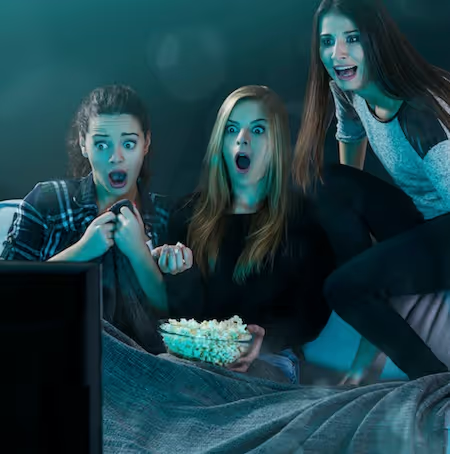
Many young people and adults love horror films and talk about how they love the feeling of being scared. This is so very different from me. I am not at all a fan. This week I have been thinking about ways to talk with kids about when horror in movies, TV shows, and online, in general, go too far.
READ MORE >
The Screenagers’ Tech Talk Tuesday blog from two weeks ago provided four questions for teens to answer regarding the HBO show Euphoria. As intended, the questions sparked conversations among adults and teens, and we got many thoughtful answers from teens in the questionnaire.
READ MORE >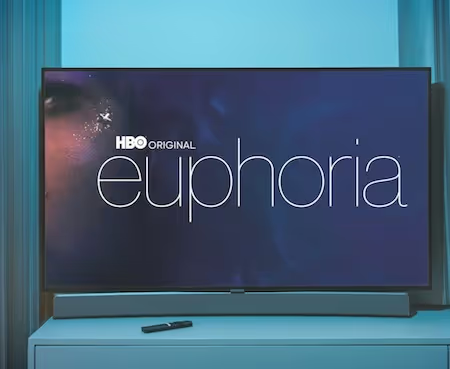
I find HBO’s Euphoria incredibly disturbing and know that although so many of our kids have watched it, many parents never have. Today, I offer a way into a conversation with youth about the show’s topics and popularity.
READ MORE >for more like this, DR. DELANEY RUSTON'S NEW BOOK, PARENTING IN THE SCREEN AGE, IS THE DEFINITIVE GUIDE FOR TODAY’S PARENTS. WITH INSIGHTS ON SCREEN TIME FROM RESEARCHERS, INPUT FROM KIDS & TEENS, THIS BOOK IS PACKED WITH SOLUTIONS FOR HOW TO START AND SUSTAIN PRODUCTIVE FAMILY TALKS ABOUT TECHNOLOGY AND IT’S IMPACT ON OUR MENTAL WELLBEING.