


Thank you all for the many amazing suggestions we received regarding future blogs and podcasts, and I can't wait to tackle them.
Last week, over three dozen states filed a lawsuit against Meta, the parent company of Facebook, Instagram, Messenger, and WhatsApp. The lawsuit alleges that Meta deliberately designed features on Instagram and Facebook to have addictive qualities, particularly for young users, despite knowing the potentially harmful effects of their technology.
The lawsuit states:
“...through its development of Instagram and Facebook, Meta created a business model focused on maximizing young users’ time and attention spent on its Social Media Platforms; (2) Meta designed and deployed harmful and psychologically manipulative product features to induce young users’ compulsive and extended Platform use, while falsely assuring the public that its features were safe and suitable for young users.”
We are at a critical point where the deceptive tactics Meta uses to keep users, especially youths, constantly engaged are getting exposed, and states are demanding accountability. Last week, ABC News interviewed me about the recent lawsuit.


Learn more about showing our movies in your school or community!
Join Screenagers filmmaker Delaney Ruston MD for our latest Podcast

Learn more about our Screen-Free Sleep campaign at the website!
Our movie made for parents and educators of younger kids
Learn more about showing our movies in your school or community!
Register your interest in bringing our new movie to your school or community
Here is the lowdown that is absolutely worth a chat with your children. It can be a shared moment to discuss the ways companies have been manipulating them and what should be done to help curb their use.
This is a moment like what happened with big tobacco when it was finally uncovered that the companies were fully aware of the harmful effects of their products but had been denying that knowledge in public.
The revelations surrounding Meta are deeply concerning, particularly regarding their knowledge of the negative impacts excessive use of their platforms can have on young people. This information was brought to light by individuals like Frances Haugen, who exposed the company's internal insights by releasing 2,200 confidential Facebook documents to The Wall Street Journal. To get a deeper view of the underpinnings of Facebook, I highly recommend Frances Haugen's new book, The Power Of One, which I am halfway through and am enjoying immensely.
I have my own experience with Facebook’s inside knowledge. Back in 2017, I was invited to the Facebook headquarters to show the first Screenagers film to their Adolescent Products Division and lead a discussion afterward. When I spoke about my concerns regarding the addictive aspects of their platforms, particularly Instagram and youth, many people on their team nodded in agreement.
In my clinic, I frequently encounter teenagers who express feelings of being trapped. For instance, a 15-year-old girl I recently saw shared that she uses social media to seek support from friends. However, she is aware that while on these platforms, she is often exposed to a barrage of images and videos that can negatively affect her mental state, leading her into a darker mindset. Additionally, she mentioned how social media sometimes presents her with seemingly quick solutions to her problems, such as easy access to drugs, a topic we delve into in our latest film, Screenagers Under the Influence: Addressing Vaping, Drugs, and Alcohol in the Digital Age.
This is the question that we can ask our kids and students.
I believe they should:
Learn more about showing our movies in your school or community!
Join Screenagers filmmaker Delaney Ruston MD for our latest Podcast
Learn more about our Screen-Free Sleep campaign at the website!
Our movie made for parents and educators of younger kids
Join Screenagers filmmaker Delaney Ruston MD for our latest Podcast
Register your interest in bringing our new movie to your school or community
This issue involves a three-pronged approach: Engaging schools, families, and the tech industries:

As we’re about to celebrate 10 years of Screenagers, we want to hear what’s been most helpful and what you’d like to see next.
Please click here to share your thoughts with us in our community survey. It only takes 5–10 minutes, and everyone who completes it will be entered to win one of five $50 Amazon vouchers.
Thank you all for the many amazing suggestions we received regarding future blogs and podcasts, and I can't wait to tackle them.
Last week, over three dozen states filed a lawsuit against Meta, the parent company of Facebook, Instagram, Messenger, and WhatsApp. The lawsuit alleges that Meta deliberately designed features on Instagram and Facebook to have addictive qualities, particularly for young users, despite knowing the potentially harmful effects of their technology.
The lawsuit states:
“...through its development of Instagram and Facebook, Meta created a business model focused on maximizing young users’ time and attention spent on its Social Media Platforms; (2) Meta designed and deployed harmful and psychologically manipulative product features to induce young users’ compulsive and extended Platform use, while falsely assuring the public that its features were safe and suitable for young users.”
We are at a critical point where the deceptive tactics Meta uses to keep users, especially youths, constantly engaged are getting exposed, and states are demanding accountability. Last week, ABC News interviewed me about the recent lawsuit.
Here is the lowdown that is absolutely worth a chat with your children. It can be a shared moment to discuss the ways companies have been manipulating them and what should be done to help curb their use.
This is a moment like what happened with big tobacco when it was finally uncovered that the companies were fully aware of the harmful effects of their products but had been denying that knowledge in public.
The revelations surrounding Meta are deeply concerning, particularly regarding their knowledge of the negative impacts excessive use of their platforms can have on young people. This information was brought to light by individuals like Frances Haugen, who exposed the company's internal insights by releasing 2,200 confidential Facebook documents to The Wall Street Journal. To get a deeper view of the underpinnings of Facebook, I highly recommend Frances Haugen's new book, The Power Of One, which I am halfway through and am enjoying immensely.
I have my own experience with Facebook’s inside knowledge. Back in 2017, I was invited to the Facebook headquarters to show the first Screenagers film to their Adolescent Products Division and lead a discussion afterward. When I spoke about my concerns regarding the addictive aspects of their platforms, particularly Instagram and youth, many people on their team nodded in agreement.
In my clinic, I frequently encounter teenagers who express feelings of being trapped. For instance, a 15-year-old girl I recently saw shared that she uses social media to seek support from friends. However, she is aware that while on these platforms, she is often exposed to a barrage of images and videos that can negatively affect her mental state, leading her into a darker mindset. Additionally, she mentioned how social media sometimes presents her with seemingly quick solutions to her problems, such as easy access to drugs, a topic we delve into in our latest film, Screenagers Under the Influence: Addressing Vaping, Drugs, and Alcohol in the Digital Age.
This is the question that we can ask our kids and students.
I believe they should:
This issue involves a three-pronged approach: Engaging schools, families, and the tech industries:
Sign up here to receive the weekly Tech Talk Tuesdays newsletter from Screenagers filmmaker Delaney Ruston MD.
We respect your privacy.
Thank you all for the many amazing suggestions we received regarding future blogs and podcasts, and I can't wait to tackle them.
Last week, over three dozen states filed a lawsuit against Meta, the parent company of Facebook, Instagram, Messenger, and WhatsApp. The lawsuit alleges that Meta deliberately designed features on Instagram and Facebook to have addictive qualities, particularly for young users, despite knowing the potentially harmful effects of their technology.
The lawsuit states:
“...through its development of Instagram and Facebook, Meta created a business model focused on maximizing young users’ time and attention spent on its Social Media Platforms; (2) Meta designed and deployed harmful and psychologically manipulative product features to induce young users’ compulsive and extended Platform use, while falsely assuring the public that its features were safe and suitable for young users.”
We are at a critical point where the deceptive tactics Meta uses to keep users, especially youths, constantly engaged are getting exposed, and states are demanding accountability. Last week, ABC News interviewed me about the recent lawsuit.

The Los Angeles Unified School District, the second-largest in the country, just approved districtwide screen time limits starting in the 2026–27 school year. Students through 1st grade won't use school devices, grades 2–5 will move from 1-to-1 iPads to shared laptop carts, and older students will face screen time limits with YouTube blocked. Devices also won't be allowed during passing periods, lunch, or recess. Credit goes to the parent- and teacher-led group Schools Beyond Screens, whose organizing and advocacy work helped make it happen.
READ MORE >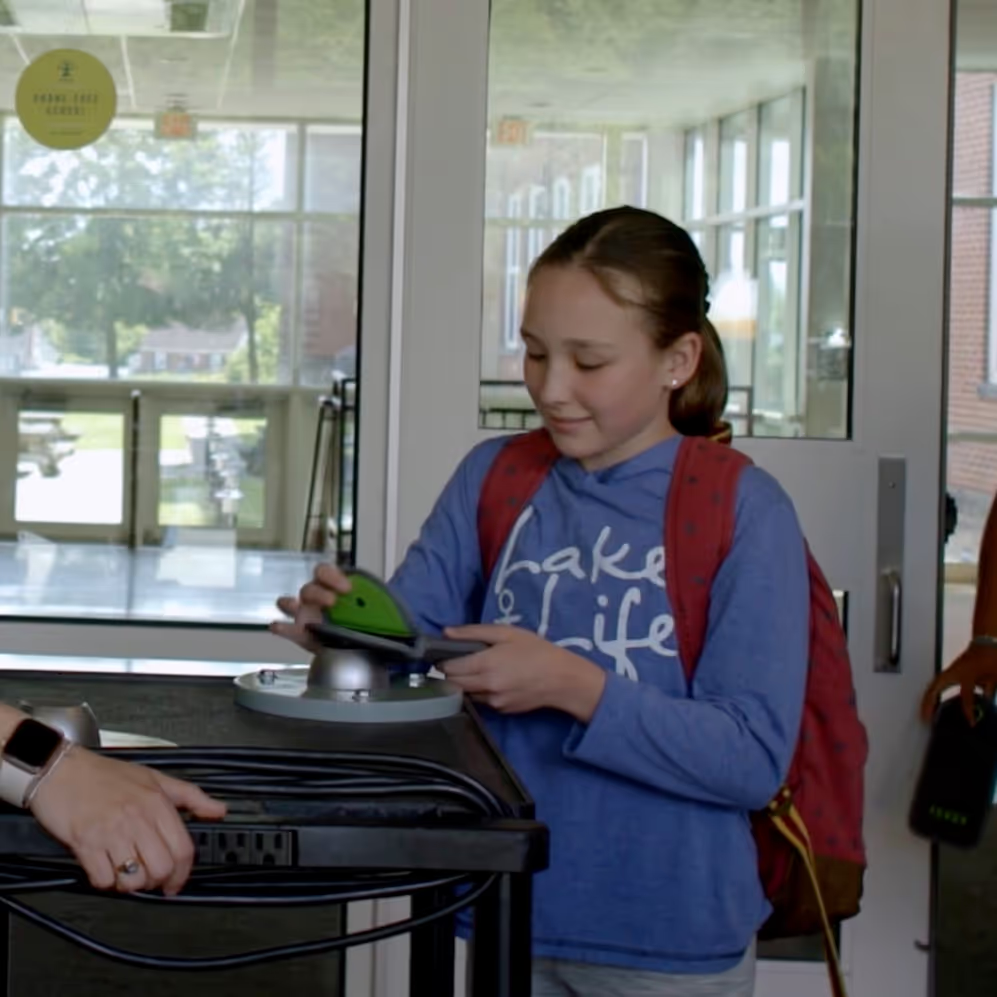
This year, millions of students are experiencing a major shift: school days without phones, smartwatches, or other personal devices. Today we explore the wins, hurdles, and solutions helping schools succeed. We also share our resources that you can use to support technology policy changes in your schools.
READ MORE >
I recently sat down with middle school principal Zach at his school in Washington State. We talked about the challenges Zach and his team faced in his early years as principal when students used phones during school, and how he brought about a powerful transformation by having phones and smartwatches put away in locked pouches for the whole school day. In today’s blog, to raise awareness of the challenges, I share five real examples from Zach of the troubling ways students use phones at school to be unkind.
READ MORE >for more like this, DR. DELANEY RUSTON'S NEW BOOK, PARENTING IN THE SCREEN AGE, IS THE DEFINITIVE GUIDE FOR TODAY’S PARENTS. WITH INSIGHTS ON SCREEN TIME FROM RESEARCHERS, INPUT FROM KIDS & TEENS, THIS BOOK IS PACKED WITH SOLUTIONS FOR HOW TO START AND SUSTAIN PRODUCTIVE FAMILY TALKS ABOUT TECHNOLOGY AND IT’S IMPACT ON OUR MENTAL WELLBEING.