

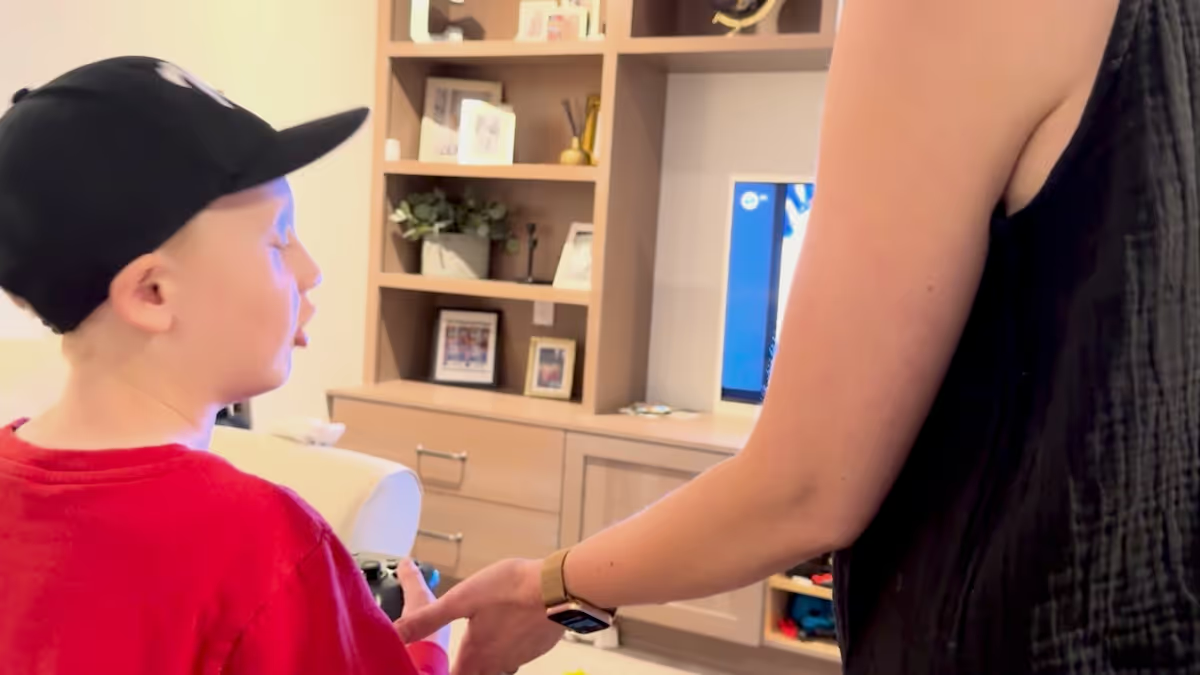

A mom reenacts a typical interaction with her 8-year-old son, Parker, in Screenagers Elementary School Age Edition:
The mom says, “Okay, Parker, five minutes….I said five minutes. Finally, he'll click it all off, click off with his friends, and then jump off the couch and tell me what a terrible parent I am.”
Sound familiar? Have you nagged at your kids to get off a screen? I sure have. In fact, who hasn’t?
I am delighted that David Yeager, a renowned developmental psychologist and author of the newly released and groundbreaking book “10 to 25,” joined me on this week's podcast to address the science of nagging and, most importantly, effective alternatives.
David, who has been in Screenagers Next Chapter and Screenagers Under the Influence, got his PhD in the lab of Carol Dweck, PhD, the brains behind growth mindsets. David continues to collaborate with her.
The podcast provides fascinating studies and clear examples of ways to improve young people’s screen time behaviors and overall motivation, such as using a mentor mindset.
Here is an excerpt from the episode that will surprise your kids when you share it with them. It is a beautifully done study looking at MRI brain scans of teens when they hear their actual moms nagging at them.
Why share this with your child? Because you are saying that you see how YOU (and all of us adults) sometimes use ineffective communication approaches.
When we express shortcomings we see in ourselves and the ways we are working to get better at something, we are modeling a growth mindset. Remember to let them know you plan to listen to the podcast to find more effective ways of handling conflict.
I recommend printing this out and reading it to your child. Or better yet, hand it to them to read out loud.


Learn more about showing our movies in your school or community!
Join Screenagers filmmaker Delaney Ruston MD for our latest Podcast

Learn more about our Screen-Free Sleep campaign at the website!
Our movie made for parents and educators of younger kids
Learn more about showing our movies in your school or community!
Register your interest in bringing our new movie to your school or community
Here’s the excerpt (with small edits for clarity sake):
Before the study, earlier in the show, David explains a term he uses, “grownsplaining.”
I share how he describes it since he uses it in this section of the study.
“It's just when adults are like, I know it's good for you. I've pieced it out of my mind, and you just need to listen to me. And if only you would listen to me, then you would make a wise choice. That's grownsplaining.”
Later in the show, about the study:
Yeager: So I've mentioned this term grownsplaining, and there's an interesting study of what happens in the teenage brain when your parent nags you and tries to groansplain something to you? This study is led by Jennifer Silk and Ron Dahl. It was a part of a broader study of moms and teenage daughter depression. They could have done it with dads and sons as well, I think.
And the way the study works is that the moms completed a sentence, ‘What bothers me about you is…’
Delaney: So they would record a bunch of their responses.
Yeager: Yeah, moms prerecorded these phrases. And they say things like, ‘What bothers me about you is I'll ask you to take your shoes downstairs, and you won't. I ask you to play with your siblings, and you know you don't, and then you yell at me.’
Delaney: Get off your screens.
Yeager: Yeah, like ‘I'll walk by a room and say it needs sweeping and dusting, and then you won't do it. You just need to calm that down.’ That's in the actual paper.
And so the teenage daughter is then in this big magnet that's spinning around in her head while they're listening to the mom's recording. And what they find is an increase in regions of the brain related to anger. So, the affective regions of the brain.
So, the one way to interpret it is the daughters are pissed off by this, groansplaining and nagging. And then a decrease in the dorsolateral prefrontal cortex, the regions of the brain related to planning, logical reasoning, et cetera.
And also, interestingly, a decrease in regions related to social cognition, the temporoparietal junction, which suggests that the teenagers aren't trying to make the most charitable possible interpretation of what their mom is saying.
Combined across these, the teenagers are not saying, ‘You know, mom, you have a point. I'm really glad you raised all these important ideas for me to change. So good chat. I'm going to get to work and I'll report back.’
It’s not what's happening. Instead, it's like their brains are shut off with respect to planning and they're just super angry.
And that's not really what you're going for as a parent… So we're just basically not going to get there with our conventional grownsplaining.
There are lots of great parenting tools and fascinating research in the podcast.
By the way, I spent some years after my medical training doing research in communication science at UC San Francisco, and I deeply believe that any time we can talk with our kids about communication research is a fabulous use of our time! Biased view? Yep!). And as AI is increasingly on the scene, raising awareness about our irreplaceable human skills is much more prescient.
Learn more about showing our movies in your school or community!
Join Screenagers filmmaker Delaney Ruston MD for our latest Podcast
Learn more about our Screen-Free Sleep campaign at the website!
Our movie made for parents and educators of younger kids
Join Screenagers filmmaker Delaney Ruston MD for our latest Podcast
Register your interest in bringing our new movie to your school or community
Be sure to subscribe to our YouTube Channel! We add new videos regularly, you'll find over 100 videos covering parenting advice, guidance, podcasts, movie clips and more. Here's our most recent:

As we’re about to celebrate 10 years of Screenagers, we want to hear what’s been most helpful and what you’d like to see next.
Please click here to share your thoughts with us in our community survey. It only takes 5–10 minutes, and everyone who completes it will be entered to win one of five $50 Amazon vouchers.
A mom reenacts a typical interaction with her 8-year-old son, Parker, in Screenagers Elementary School Age Edition:
The mom says, “Okay, Parker, five minutes….I said five minutes. Finally, he'll click it all off, click off with his friends, and then jump off the couch and tell me what a terrible parent I am.”
Sound familiar? Have you nagged at your kids to get off a screen? I sure have. In fact, who hasn’t?
I am delighted that David Yeager, a renowned developmental psychologist and author of the newly released and groundbreaking book “10 to 25,” joined me on this week's podcast to address the science of nagging and, most importantly, effective alternatives.
David, who has been in Screenagers Next Chapter and Screenagers Under the Influence, got his PhD in the lab of Carol Dweck, PhD, the brains behind growth mindsets. David continues to collaborate with her.
The podcast provides fascinating studies and clear examples of ways to improve young people’s screen time behaviors and overall motivation, such as using a mentor mindset.
Here is an excerpt from the episode that will surprise your kids when you share it with them. It is a beautifully done study looking at MRI brain scans of teens when they hear their actual moms nagging at them.
Why share this with your child? Because you are saying that you see how YOU (and all of us adults) sometimes use ineffective communication approaches.
When we express shortcomings we see in ourselves and the ways we are working to get better at something, we are modeling a growth mindset. Remember to let them know you plan to listen to the podcast to find more effective ways of handling conflict.
I recommend printing this out and reading it to your child. Or better yet, hand it to them to read out loud.
Here’s the excerpt (with small edits for clarity sake):
Before the study, earlier in the show, David explains a term he uses, “grownsplaining.”
I share how he describes it since he uses it in this section of the study.
“It's just when adults are like, I know it's good for you. I've pieced it out of my mind, and you just need to listen to me. And if only you would listen to me, then you would make a wise choice. That's grownsplaining.”
Later in the show, about the study:
Yeager: So I've mentioned this term grownsplaining, and there's an interesting study of what happens in the teenage brain when your parent nags you and tries to groansplain something to you? This study is led by Jennifer Silk and Ron Dahl. It was a part of a broader study of moms and teenage daughter depression. They could have done it with dads and sons as well, I think.
And the way the study works is that the moms completed a sentence, ‘What bothers me about you is…’
Delaney: So they would record a bunch of their responses.
Yeager: Yeah, moms prerecorded these phrases. And they say things like, ‘What bothers me about you is I'll ask you to take your shoes downstairs, and you won't. I ask you to play with your siblings, and you know you don't, and then you yell at me.’
Delaney: Get off your screens.
Yeager: Yeah, like ‘I'll walk by a room and say it needs sweeping and dusting, and then you won't do it. You just need to calm that down.’ That's in the actual paper.
And so the teenage daughter is then in this big magnet that's spinning around in her head while they're listening to the mom's recording. And what they find is an increase in regions of the brain related to anger. So, the affective regions of the brain.
So, the one way to interpret it is the daughters are pissed off by this, groansplaining and nagging. And then a decrease in the dorsolateral prefrontal cortex, the regions of the brain related to planning, logical reasoning, et cetera.
And also, interestingly, a decrease in regions related to social cognition, the temporoparietal junction, which suggests that the teenagers aren't trying to make the most charitable possible interpretation of what their mom is saying.
Combined across these, the teenagers are not saying, ‘You know, mom, you have a point. I'm really glad you raised all these important ideas for me to change. So good chat. I'm going to get to work and I'll report back.’
It’s not what's happening. Instead, it's like their brains are shut off with respect to planning and they're just super angry.
And that's not really what you're going for as a parent… So we're just basically not going to get there with our conventional grownsplaining.
There are lots of great parenting tools and fascinating research in the podcast.
By the way, I spent some years after my medical training doing research in communication science at UC San Francisco, and I deeply believe that any time we can talk with our kids about communication research is a fabulous use of our time! Biased view? Yep!). And as AI is increasingly on the scene, raising awareness about our irreplaceable human skills is much more prescient.
Be sure to subscribe to our YouTube Channel! We add new videos regularly, you'll find over 100 videos covering parenting advice, guidance, podcasts, movie clips and more. Here's our most recent:
Sign up here to receive the weekly Tech Talk Tuesdays newsletter from Screenagers filmmaker Delaney Ruston MD.
We respect your privacy.
A mom reenacts a typical interaction with her 8-year-old son, Parker, in Screenagers Elementary School Age Edition:
The mom says, “Okay, Parker, five minutes….I said five minutes. Finally, he'll click it all off, click off with his friends, and then jump off the couch and tell me what a terrible parent I am.”
Sound familiar? Have you nagged at your kids to get off a screen? I sure have. In fact, who hasn’t?
I am delighted that David Yeager, a renowned developmental psychologist and author of the newly released and groundbreaking book “10 to 25,” joined me on this week's podcast to address the science of nagging and, most importantly, effective alternatives.
David, who has been in Screenagers Next Chapter and Screenagers Under the Influence, got his PhD in the lab of Carol Dweck, PhD, the brains behind growth mindsets. David continues to collaborate with her.
The podcast provides fascinating studies and clear examples of ways to improve young people’s screen time behaviors and overall motivation, such as using a mentor mindset.
Here is an excerpt from the episode that will surprise your kids when you share it with them. It is a beautifully done study looking at MRI brain scans of teens when they hear their actual moms nagging at them.
Why share this with your child? Because you are saying that you see how YOU (and all of us adults) sometimes use ineffective communication approaches.
When we express shortcomings we see in ourselves and the ways we are working to get better at something, we are modeling a growth mindset. Remember to let them know you plan to listen to the podcast to find more effective ways of handling conflict.
I recommend printing this out and reading it to your child. Or better yet, hand it to them to read out loud.
I've been noticing the ways I can be rude, in person and on my phone. This week I share two recent examples of my own, plus why correcting myself out loud strengthens self-awareness. The talk that follows isn't about your kid. It's about you going first.
READ MORE >
An Oakland library has started lending out sports equipment and games alongside books, so families can borrow gear to use at nearby parks. It is a reminder that borrowing and lending between families is a simple way to fill a summer afternoon without a screen, while quietly modelling generosity and humility. We are out of practice at asking, but the person on the other end is usually glad to help.
READ MORE >
E-readers are convenient, but there are three reasons to lean toward paper books this summer. First, e-readers are screens, and the pull of everything else you could do on one makes it harder to stay immersed. Second, a large meta-analysis found people understand and remember slightly better on paper, especially with longer texts. Third, easy access to endless book samples makes it too tempting to jump ship rather than work through the slower parts, since reading, unlike TikTok, is about delayed gratification.
READ MORE >for more like this, DR. DELANEY RUSTON'S NEW BOOK, PARENTING IN THE SCREEN AGE, IS THE DEFINITIVE GUIDE FOR TODAY’S PARENTS. WITH INSIGHTS ON SCREEN TIME FROM RESEARCHERS, INPUT FROM KIDS & TEENS, THIS BOOK IS PACKED WITH SOLUTIONS FOR HOW TO START AND SUSTAIN PRODUCTIVE FAMILY TALKS ABOUT TECHNOLOGY AND IT’S IMPACT ON OUR MENTAL WELLBEING.