


“Anytime we've introduced a new ritual into our family, it's made our family better.” — Tiffany Shlain
As the world starts to open up more, and household members are newly pulled in different directions, I thought it was the perfect time to consider how families can create routines to feel connected.
I’m currently gathering stories to share about families experimenting with defined times for togetherness, undivided by screens. And if you have one that you might want to share (and it can be anonymous if you want), please email me at delaney@screenagersmovie.
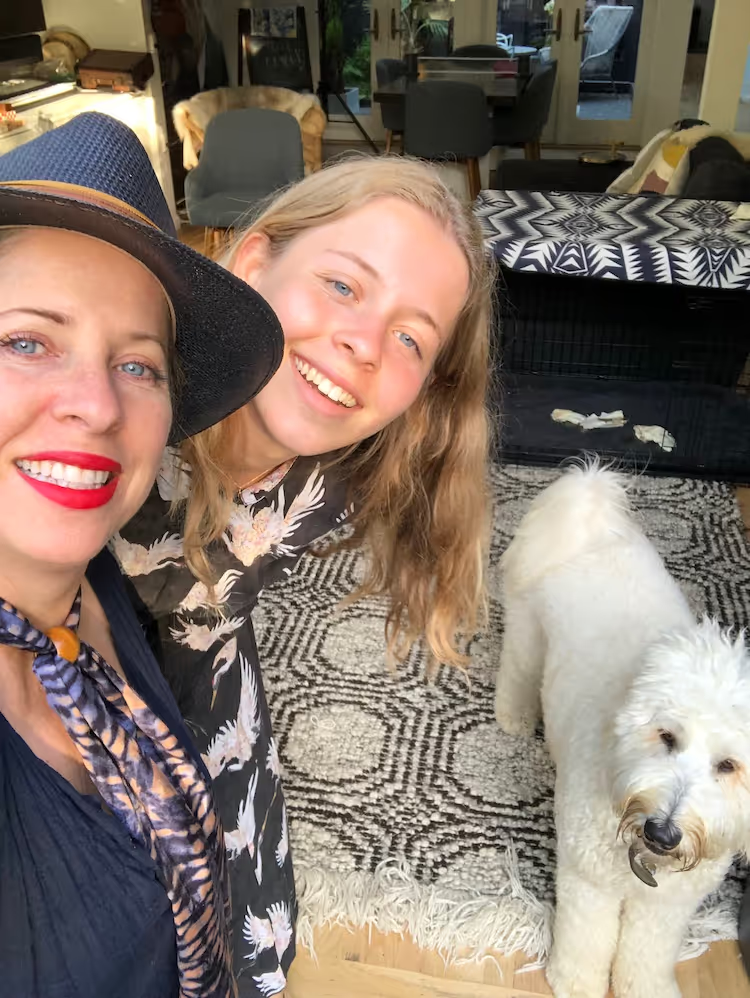
For the first one, I interviewed Tiffany Shlain, a fellow filmmaker, and changemaker along with her daughter Odessa, who is graduating from high school this year. Tiffany has been interested in the issue of tech balance for a long time, and last year she published a book called 24/6, The Power of Unplugging One Day a Week. At its core, it looks at how her family has been unplugging for years with their weekly “Tech Shabbat.”
I interviewed Tiffany and Odessa for the Screenagers Podcast and had such a fun and enlightening conversation. I got gritty in asking about all the obstacles and pushbacks I could see happening in many homes with their setup. I highly recommend listening to the Screenagers Podcast with any youth in your life.
In the meantime, here are some excerpts from the interview. There are many more practical takeaways in the full podcast episode. (Of note, the text below has some slight editing from the actual podcast for clarity).
Odessa: “We don't use a screen for 24 hours from Friday night to Saturday night — from Shabbat dinner on Friday night, which is around seven now until 5 pm sharp on Saturday.”
Tiffany: “The Start Time of Shabbat kind of changes depending on the weather. We've been having it outside, and we've been doing it for over 11 years.”
Tiffany: “I'm Jewish, we are not religious, but I would say very culturally Jewish. For those that don't know what Shabbat is, for most American Jews, it’s like a nice Friday night meal with candles, challah, [and such] …and we have done a modern interpretation of it in our home, which we call Tech Shabbat, which means no screens because to us, that is rest in the 21st century when we're so inundated with screens and notifications. It really is about turning off screens.
Where it started was I was feeling so distracted. My husband and I are very immersed in tech. He's a professor of robotics. I founded the Webby Awards. …We got the iPhones first out of the gate. And I hated the way I was feeling so distracted. And then I had this dramatic couple of weeks in my life where I lost my father to brain cancer, and my second daughter Blooma was born. [Blooma is now 12] It was really one of those wake-up moments of life grabbing me by the shoulders and saying, how do you want to live your life.”


Learn more about showing our movies in your school or community!
Join Screenagers filmmaker Delaney Ruston MD for our latest Podcast

Learn more about our Screen-Free Sleep campaign at the website!
Our movie made for parents and educators of younger kids
Learn more about showing our movies in your school or community!
Register your interest in bringing our new movie to your school or community
Odessa: “I don't consider it as depriving myself of anything. I do remember when we started, I was six. I remember the significant factor was that I was not going to have any Saturday morning cartoons. But since then, it's really something I do, just like another contour of my week.”
Odessa: “Friday night usually starts with my mom and I going to Whole Foods to pick up groceries for our Shabbat dinner, and then we have like a half-hour of setting up, we put on music and set out appetizers. Then, we have our guests, we have this big Shabbat dinner outside where we have lots of rituals with our Shabbat, and we have the same exact food every Friday.”
Tiffany:“It's all home-cooked, same meal every time.”
Odessa: “And then we sleep really well. And then the next morning, we do a variety of things, but there are some common themes. Normally it's sleeping in, we go on a walk with our dog and some other sort of hike or physical activity. Sometimes we go to the farmers market or cook some elaborate meal.”
Tiffany: “We read, and we play music. It’s like a day of joy but kind of like analog joy.”
Odessa: “No work, that is the central tenet of Shabbat.”
Tiffany: “We've done it with two kids in soccer. If it's a crazy emergency, we do have a landline. I had a mom on another team that would call me if the field changed, but we've had only a couple mess ups in 11 years.”
Odessa: “I don't normally make plans for Saturday because honestly, like, even though socializing is wonderful, it's another kind of work. It’s not that I don't enjoy seeing my friends. I do recognize that as an introvert, it's draining for me.”
(In the podcast, Odessa does mention exceptions.)
Learn more about showing our movies in your school or community!
Join Screenagers filmmaker Delaney Ruston MD for our latest Podcast
Learn more about our Screen-Free Sleep campaign at the website!
Our movie made for parents and educators of younger kids
Join Screenagers filmmaker Delaney Ruston MD for our latest Podcast
Register your interest in bringing our new movie to your school or community
Tiffany: “I will usually send an email right before they [guests] come, asking if they have any food allergies, here’s our address again, and I give a reminder, we're screen-free. And most of the time, people remember.”
Odessa: “It's going to be a little bit more difficult when my whole family is not going to be doing Tech Shabbat around me because right now, it's definitely like we live in a little bit of a bubble. But I definitely plan not to do homework on Shabbat and to use my phone as little as possible. But also noting that I might need it for navigation or things I can’t avoid.
Tiffany: “In my book 24/6, there's a lot of different strategies, because you don't want to say to your kids, no screens one day a week, that's like the worst approach to anything … i.e., things being taken away. Instead, what do we all wish we did more of as a family — and then fill the day with that. It has to be a day of joy, or it’s not going to work.”

As we’re about to celebrate 10 years of Screenagers, we want to hear what’s been most helpful and what you’d like to see next.
Please click here to share your thoughts with us in our community survey. It only takes 5–10 minutes, and everyone who completes it will be entered to win one of five $50 Amazon vouchers.
“Anytime we've introduced a new ritual into our family, it's made our family better.” — Tiffany Shlain
As the world starts to open up more, and household members are newly pulled in different directions, I thought it was the perfect time to consider how families can create routines to feel connected.
I’m currently gathering stories to share about families experimenting with defined times for togetherness, undivided by screens. And if you have one that you might want to share (and it can be anonymous if you want), please email me at delaney@screenagersmovie.
For the first one, I interviewed Tiffany Shlain, a fellow filmmaker, and changemaker along with her daughter Odessa, who is graduating from high school this year. Tiffany has been interested in the issue of tech balance for a long time, and last year she published a book called 24/6, The Power of Unplugging One Day a Week. At its core, it looks at how her family has been unplugging for years with their weekly “Tech Shabbat.”
I interviewed Tiffany and Odessa for the Screenagers Podcast and had such a fun and enlightening conversation. I got gritty in asking about all the obstacles and pushbacks I could see happening in many homes with their setup. I highly recommend listening to the Screenagers Podcast with any youth in your life.
In the meantime, here are some excerpts from the interview. There are many more practical takeaways in the full podcast episode. (Of note, the text below has some slight editing from the actual podcast for clarity).
Odessa: “We don't use a screen for 24 hours from Friday night to Saturday night — from Shabbat dinner on Friday night, which is around seven now until 5 pm sharp on Saturday.”
Tiffany: “The Start Time of Shabbat kind of changes depending on the weather. We've been having it outside, and we've been doing it for over 11 years.”
Tiffany: “I'm Jewish, we are not religious, but I would say very culturally Jewish. For those that don't know what Shabbat is, for most American Jews, it’s like a nice Friday night meal with candles, challah, [and such] …and we have done a modern interpretation of it in our home, which we call Tech Shabbat, which means no screens because to us, that is rest in the 21st century when we're so inundated with screens and notifications. It really is about turning off screens.
Where it started was I was feeling so distracted. My husband and I are very immersed in tech. He's a professor of robotics. I founded the Webby Awards. …We got the iPhones first out of the gate. And I hated the way I was feeling so distracted. And then I had this dramatic couple of weeks in my life where I lost my father to brain cancer, and my second daughter Blooma was born. [Blooma is now 12] It was really one of those wake-up moments of life grabbing me by the shoulders and saying, how do you want to live your life.”
Odessa: “I don't consider it as depriving myself of anything. I do remember when we started, I was six. I remember the significant factor was that I was not going to have any Saturday morning cartoons. But since then, it's really something I do, just like another contour of my week.”
Odessa: “Friday night usually starts with my mom and I going to Whole Foods to pick up groceries for our Shabbat dinner, and then we have like a half-hour of setting up, we put on music and set out appetizers. Then, we have our guests, we have this big Shabbat dinner outside where we have lots of rituals with our Shabbat, and we have the same exact food every Friday.”
Tiffany:“It's all home-cooked, same meal every time.”
Odessa: “And then we sleep really well. And then the next morning, we do a variety of things, but there are some common themes. Normally it's sleeping in, we go on a walk with our dog and some other sort of hike or physical activity. Sometimes we go to the farmers market or cook some elaborate meal.”
Tiffany: “We read, and we play music. It’s like a day of joy but kind of like analog joy.”
Odessa: “No work, that is the central tenet of Shabbat.”
Tiffany: “We've done it with two kids in soccer. If it's a crazy emergency, we do have a landline. I had a mom on another team that would call me if the field changed, but we've had only a couple mess ups in 11 years.”
Odessa: “I don't normally make plans for Saturday because honestly, like, even though socializing is wonderful, it's another kind of work. It’s not that I don't enjoy seeing my friends. I do recognize that as an introvert, it's draining for me.”
(In the podcast, Odessa does mention exceptions.)
Tiffany: “I will usually send an email right before they [guests] come, asking if they have any food allergies, here’s our address again, and I give a reminder, we're screen-free. And most of the time, people remember.”
Odessa: “It's going to be a little bit more difficult when my whole family is not going to be doing Tech Shabbat around me because right now, it's definitely like we live in a little bit of a bubble. But I definitely plan not to do homework on Shabbat and to use my phone as little as possible. But also noting that I might need it for navigation or things I can’t avoid.
Tiffany: “In my book 24/6, there's a lot of different strategies, because you don't want to say to your kids, no screens one day a week, that's like the worst approach to anything … i.e., things being taken away. Instead, what do we all wish we did more of as a family — and then fill the day with that. It has to be a day of joy, or it’s not going to work.”
Sign up here to receive the weekly Tech Talk Tuesdays newsletter from Screenagers filmmaker Delaney Ruston MD.
We respect your privacy.
“Anytime we've introduced a new ritual into our family, it's made our family better.” — Tiffany Shlain
As the world starts to open up more, and household members are newly pulled in different directions, I thought it was the perfect time to consider how families can create routines to feel connected.
I’m currently gathering stories to share about families experimenting with defined times for togetherness, undivided by screens. And if you have one that you might want to share (and it can be anonymous if you want), please email me at delaney@screenagersmovie.
For the first one, I interviewed Tiffany Shlain, a fellow filmmaker, and changemaker along with her daughter Odessa, who is graduating from high school this year. Tiffany has been interested in the issue of tech balance for a long time, and last year she published a book called 24/6, The Power of Unplugging One Day a Week. At its core, it looks at how her family has been unplugging for years with their weekly “Tech Shabbat.”
I interviewed Tiffany and Odessa for the Screenagers Podcast and had such a fun and enlightening conversation. I got gritty in asking about all the obstacles and pushbacks I could see happening in many homes with their setup. I highly recommend listening to the Screenagers Podcast with any youth in your life.
In the meantime, here are some excerpts from the interview. There are many more practical takeaways in the full podcast episode. (Of note, the text below has some slight editing from the actual podcast for clarity).
Odessa: “We don't use a screen for 24 hours from Friday night to Saturday night — from Shabbat dinner on Friday night, which is around seven now until 5 pm sharp on Saturday.”
Tiffany: “The Start Time of Shabbat kind of changes depending on the weather. We've been having it outside, and we've been doing it for over 11 years.”
Tiffany: “I'm Jewish, we are not religious, but I would say very culturally Jewish. For those that don't know what Shabbat is, for most American Jews, it’s like a nice Friday night meal with candles, challah, [and such] …and we have done a modern interpretation of it in our home, which we call Tech Shabbat, which means no screens because to us, that is rest in the 21st century when we're so inundated with screens and notifications. It really is about turning off screens.
Where it started was I was feeling so distracted. My husband and I are very immersed in tech. He's a professor of robotics. I founded the Webby Awards. …We got the iPhones first out of the gate. And I hated the way I was feeling so distracted. And then I had this dramatic couple of weeks in my life where I lost my father to brain cancer, and my second daughter Blooma was born. [Blooma is now 12] It was really one of those wake-up moments of life grabbing me by the shoulders and saying, how do you want to live your life.”
I've been noticing the ways I can be rude, in person and on my phone. This week I share two recent examples of my own, plus why correcting myself out loud strengthens self-awareness. The talk that follows isn't about your kid. It's about you going first.
READ MORE >
An Oakland library has started lending out sports equipment and games alongside books, so families can borrow gear to use at nearby parks. It is a reminder that borrowing and lending between families is a simple way to fill a summer afternoon without a screen, while quietly modelling generosity and humility. We are out of practice at asking, but the person on the other end is usually glad to help.
READ MORE >
E-readers are convenient, but there are three reasons to lean toward paper books this summer. First, e-readers are screens, and the pull of everything else you could do on one makes it harder to stay immersed. Second, a large meta-analysis found people understand and remember slightly better on paper, especially with longer texts. Third, easy access to endless book samples makes it too tempting to jump ship rather than work through the slower parts, since reading, unlike TikTok, is about delayed gratification.
READ MORE >for more like this, DR. DELANEY RUSTON'S NEW BOOK, PARENTING IN THE SCREEN AGE, IS THE DEFINITIVE GUIDE FOR TODAY’S PARENTS. WITH INSIGHTS ON SCREEN TIME FROM RESEARCHERS, INPUT FROM KIDS & TEENS, THIS BOOK IS PACKED WITH SOLUTIONS FOR HOW TO START AND SUSTAIN PRODUCTIVE FAMILY TALKS ABOUT TECHNOLOGY AND IT’S IMPACT ON OUR MENTAL WELLBEING.