

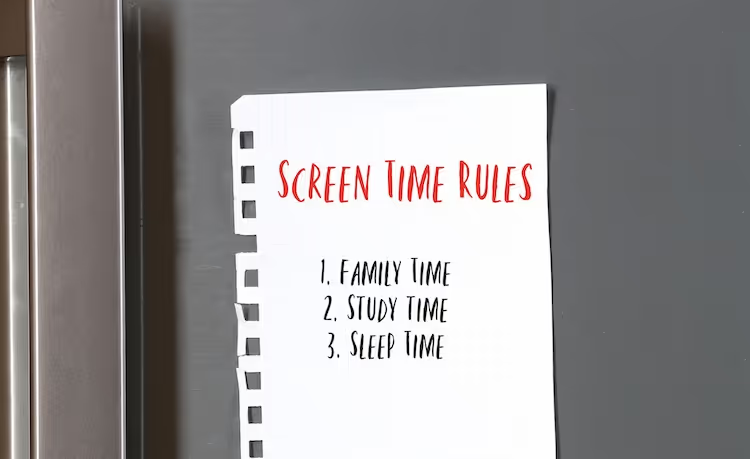

Screen-time challenges tend to fall into three areas: family time, study time, and sleep time. Clear rules in each can reduce conflict and help kids build healthier habits, whether that means keeping phones out of bedrooms, limiting device use during homework, or deciding how phones are handled during outings and meals. Different ages and situations call for different approaches, and flexibility matters, but thoughtful structure can support better focus, connection, and rest.
Last week, I wrote about my top 3 steps for successfully creating healthier tech policies at home. Folks got back to me requesting specific screen time policies to consider. My past blogs have provided examples, but I’ll expand further today.
I want to share my top 3 main screen time categories and offer many options of rules that can be tailored to your specific family. Let’s be real that policies for a 10-year-old will be different for a 17-year-old. Then there are factors such as kid’s maturity levels, outside activities, sibling dynamics, bandwidth of parents/guardians, and the list goes on. For this reason, having many ideas can be helpful.
Let’s get started. The three screen time categories are the following:


Learn more about showing our movies in your school or community!
Join Screenagers filmmaker Delaney Ruston MD for our latest Podcast

Learn more about our Screen-Free Sleep campaign at the website!
Our movie made for parents and educators of younger kids
Learn more about showing our movies in your school or community!
Register your interest in bringing our new movie to your school or community
I put this under family time because it is such an important time for chatting, listening to the radio together, and watching the world pass by together…
What is helpful about this waiting-to-drive technique is that it is natural to want to get going when you get in a car, so it helps to ensure the set time period happens with less “wait, wait, just one more minute.” Also, it models uncoupling being on the phone while the car is moving.
Or the policy might be that phones and devices are away for routine weekly driving, but things are different for longer car rides.
For meals apart (i.e., weekday breakfasts), perhaps they are allowed to be on their device a couple of mornings or even every morning (as is often the case with older teens)
Perhaps the family sits down, and everyone gets to check their phone for a couple of minutes before phones get put away. This can be helpful if a parent has had the habit of checking or needing to answer work calls at dinner-this quick check can prevent such things.
There is NOTHING straightforward about parenting screen time when it comes to our kids’ study time. Intertwining the tools with the treats of tech was one of the main reasons I started all this work. One thing, though, that has become ever more clear is that the last thing we want to do is engage in a cat-and-mouse chase when it comes to kids and their homework. We are not trying to trap and punish them but are working with them to get schoolwork done in light of the 4 billion and thirty-three tempting treats on devices.
Learn more about showing our movies in your school or community!
Join Screenagers filmmaker Delaney Ruston MD for our latest Podcast
Learn more about our Screen-Free Sleep campaign at the website!
Our movie made for parents and educators of younger kids
Join Screenagers filmmaker Delaney Ruston MD for our latest Podcast
Register your interest in bringing our new movie to your school or community
What is beautiful about a specific bedtime is that this gives them an extra incentive not to switch tabs on their computers as much — meaning they know that if they dip into digital playgrounds rather than finish the work at hand, they will face the natural consequence of getting behind. I know it is scary to think that they won’t regulate well and they will miss doing assignments. Yet, by staying firm, our kids can learn to manage their time better and better. If they cannot, then getting advice and support is appropriate.
What about if their bedtime is after yours? Commit to staying up to whatever bedtime gets set. Later, when the system is in place, and they know to drop off devices in your room at the time decided, you can hit the hay earlier. Many families have made this work. It is worth a try if you are not yet one of them.
It is not surprising that reading these rules can spark judgments in us, such as, "Wow, that policy seems way too lenient. Or no way about that one, it seems so over-controlling." But remember, we are talking about a large range of ages, and one never knows the full breadth of what is happening in any home around tech time and non-tech time.
And finally, I firmly believe that we, our kids and us, are all doing the best we can at any given moment given our internal and external resources. Onward with grace to all of us!
1. Now that we are back (or nearly back in school), what was the smoothest area regarding screen time rules among these three categories? Study time, family time, or sleep time?
2. What was the hardest of the three?
3. Let’s experiment with a new policy. What do we think of the ideas mentioned here, and what ideas do we all have?

As we’re about to celebrate 10 years of Screenagers, we want to hear what’s been most helpful and what you’d like to see next.
Please click here to share your thoughts with us in our community survey. It only takes 5–10 minutes, and everyone who completes it will be entered to win one of five $50 Amazon vouchers.
Last week, I wrote about my top 3 steps for successfully creating healthier tech policies at home. Folks got back to me requesting specific screen time policies to consider. My past blogs have provided examples, but I’ll expand further today.
I want to share my top 3 main screen time categories and offer many options of rules that can be tailored to your specific family. Let’s be real that policies for a 10-year-old will be different for a 17-year-old. Then there are factors such as kid’s maturity levels, outside activities, sibling dynamics, bandwidth of parents/guardians, and the list goes on. For this reason, having many ideas can be helpful.
Let’s get started. The three screen time categories are the following:
I put this under family time because it is such an important time for chatting, listening to the radio together, and watching the world pass by together…
What is helpful about this waiting-to-drive technique is that it is natural to want to get going when you get in a car, so it helps to ensure the set time period happens with less “wait, wait, just one more minute.” Also, it models uncoupling being on the phone while the car is moving.
Or the policy might be that phones and devices are away for routine weekly driving, but things are different for longer car rides.
For meals apart (i.e., weekday breakfasts), perhaps they are allowed to be on their device a couple of mornings or even every morning (as is often the case with older teens)
Perhaps the family sits down, and everyone gets to check their phone for a couple of minutes before phones get put away. This can be helpful if a parent has had the habit of checking or needing to answer work calls at dinner-this quick check can prevent such things.
There is NOTHING straightforward about parenting screen time when it comes to our kids’ study time. Intertwining the tools with the treats of tech was one of the main reasons I started all this work. One thing, though, that has become ever more clear is that the last thing we want to do is engage in a cat-and-mouse chase when it comes to kids and their homework. We are not trying to trap and punish them but are working with them to get schoolwork done in light of the 4 billion and thirty-three tempting treats on devices.
What is beautiful about a specific bedtime is that this gives them an extra incentive not to switch tabs on their computers as much — meaning they know that if they dip into digital playgrounds rather than finish the work at hand, they will face the natural consequence of getting behind. I know it is scary to think that they won’t regulate well and they will miss doing assignments. Yet, by staying firm, our kids can learn to manage their time better and better. If they cannot, then getting advice and support is appropriate.
What about if their bedtime is after yours? Commit to staying up to whatever bedtime gets set. Later, when the system is in place, and they know to drop off devices in your room at the time decided, you can hit the hay earlier. Many families have made this work. It is worth a try if you are not yet one of them.
It is not surprising that reading these rules can spark judgments in us, such as, "Wow, that policy seems way too lenient. Or no way about that one, it seems so over-controlling." But remember, we are talking about a large range of ages, and one never knows the full breadth of what is happening in any home around tech time and non-tech time.
And finally, I firmly believe that we, our kids and us, are all doing the best we can at any given moment given our internal and external resources. Onward with grace to all of us!
1. Now that we are back (or nearly back in school), what was the smoothest area regarding screen time rules among these three categories? Study time, family time, or sleep time?
2. What was the hardest of the three?
3. Let’s experiment with a new policy. What do we think of the ideas mentioned here, and what ideas do we all have?
Sign up here to receive the weekly Tech Talk Tuesdays newsletter from Screenagers filmmaker Delaney Ruston MD.
We respect your privacy.
Last week, I wrote about my top 3 steps for successfully creating healthier tech policies at home. Folks got back to me requesting specific screen time policies to consider. My past blogs have provided examples, but I’ll expand further today.
I want to share my top 3 main screen time categories and offer many options of rules that can be tailored to your specific family. Let’s be real that policies for a 10-year-old will be different for a 17-year-old. Then there are factors such as kid’s maturity levels, outside activities, sibling dynamics, bandwidth of parents/guardians, and the list goes on. For this reason, having many ideas can be helpful.
Let’s get started. The three screen time categories are the following:

I've been noticing the ways I can be rude, in person and on my phone. This week I share two recent examples of my own, plus why correcting myself out loud strengthens self-awareness. The talk that follows isn't about your kid. It's about you going first.
READ MORE >
An Oakland library has started lending out sports equipment and games alongside books, so families can borrow gear to use at nearby parks. It is a reminder that borrowing and lending between families is a simple way to fill a summer afternoon without a screen, while quietly modelling generosity and humility. We are out of practice at asking, but the person on the other end is usually glad to help.
READ MORE >
E-readers are convenient, but there are three reasons to lean toward paper books this summer. First, e-readers are screens, and the pull of everything else you could do on one makes it harder to stay immersed. Second, a large meta-analysis found people understand and remember slightly better on paper, especially with longer texts. Third, easy access to endless book samples makes it too tempting to jump ship rather than work through the slower parts, since reading, unlike TikTok, is about delayed gratification.
READ MORE >for more like this, DR. DELANEY RUSTON'S NEW BOOK, PARENTING IN THE SCREEN AGE, IS THE DEFINITIVE GUIDE FOR TODAY’S PARENTS. WITH INSIGHTS ON SCREEN TIME FROM RESEARCHERS, INPUT FROM KIDS & TEENS, THIS BOOK IS PACKED WITH SOLUTIONS FOR HOW TO START AND SUSTAIN PRODUCTIVE FAMILY TALKS ABOUT TECHNOLOGY AND IT’S IMPACT ON OUR MENTAL WELLBEING.