


The American Academy of Sleep Medicine (AASM) just released recommendations for the number of hours a night that kids and teens need to sleep, to function at their best.
“Sleep is essential for a healthy life, and it is important to promote healthy sleep habits in early childhood,” said Dr. Shalini Paruthi, Pediatric Consensus Panel moderator, and fellow of the American Academy of Sleep Medicine. “It is especially important as children reach adolescence to continue to ensure that teens are able to get sufficient sleep.”
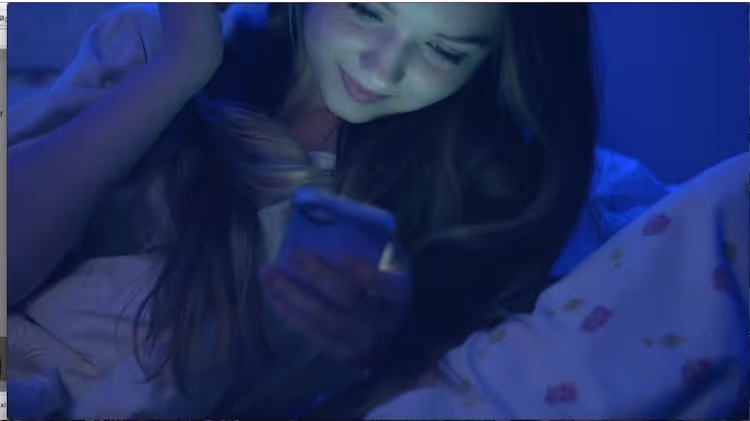
Several studies show that small screens in the bedroom can disrupt sleep. In February 2015, the journal Pediatrics published a study of 2048 4th- and 7th-graders which found that sleeping with a small screen decreased sleep time by 20 minutes, usually because of delayed bedtimes.
In SCREENAGERS Dr. Leslie Walker MD says:
"One of the most common reasons kids come to the pediatrician , and teenagers in particular, is because they are having trouble with sleep. Having so many kinds of technology in the room really stops some kids from being able to sleep."
The new sleep recommendations come from a project conducted by 13 of the foremost sleep experts:
"The Pediatric Consensus Panel found that sleeping the number of recommended hours on a regular basis is associated with overall better health outcomes including: improved attention, behavior, learning, memory, emotional regulation, quality of life, and mental and physical health."
The Panel also found a link between sleeping fewer than recommended and physical disorders like hypertension, obesity, and diabetes as well as increased psychological problems like depression and suicidal thoughts.


Learn more about showing our movies in your school or community!
Join Screenagers filmmaker Delaney Ruston MD for our latest Podcast

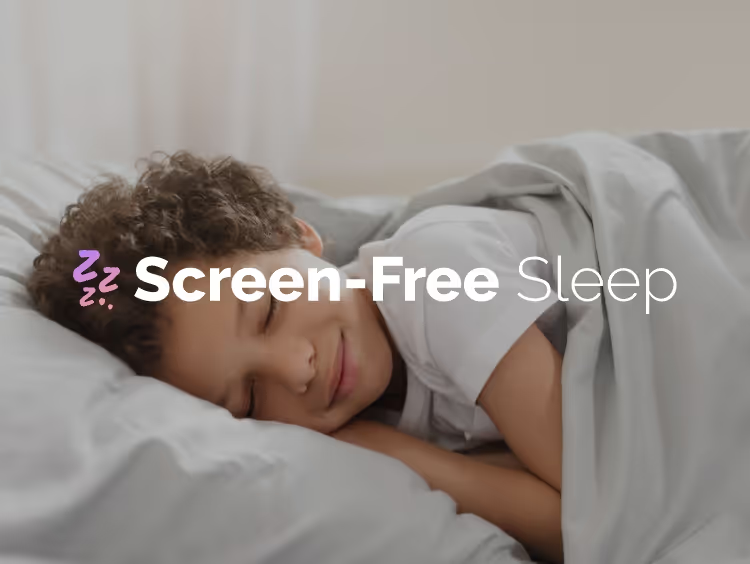
Learn more about our Screen-Free Sleep campaign at the website!
Our movie made for parents and educators of younger kids
Learn more about showing our movies in your school or community!
Register your interest in bringing our new movie to your school or community
Learn more about showing our movies in your school or community!
Join Screenagers filmmaker Delaney Ruston MD for our latest Podcast
Learn more about our Screen-Free Sleep campaign at the website!
Our movie made for parents and educators of younger kids
Join Screenagers filmmaker Delaney Ruston MD for our latest Podcast
Register your interest in bringing our new movie to your school or community

As we’re about to celebrate 10 years of Screenagers, we want to hear what’s been most helpful and what you’d like to see next.
Please click here to share your thoughts with us in our community survey. It only takes 5–10 minutes, and everyone who completes it will be entered to win one of five $50 Amazon vouchers.
The American Academy of Sleep Medicine (AASM) just released recommendations for the number of hours a night that kids and teens need to sleep, to function at their best.
“Sleep is essential for a healthy life, and it is important to promote healthy sleep habits in early childhood,” said Dr. Shalini Paruthi, Pediatric Consensus Panel moderator, and fellow of the American Academy of Sleep Medicine. “It is especially important as children reach adolescence to continue to ensure that teens are able to get sufficient sleep.”
Several studies show that small screens in the bedroom can disrupt sleep. In February 2015, the journal Pediatrics published a study of 2048 4th- and 7th-graders which found that sleeping with a small screen decreased sleep time by 20 minutes, usually because of delayed bedtimes.
In SCREENAGERS Dr. Leslie Walker MD says:
"One of the most common reasons kids come to the pediatrician , and teenagers in particular, is because they are having trouble with sleep. Having so many kinds of technology in the room really stops some kids from being able to sleep."
The new sleep recommendations come from a project conducted by 13 of the foremost sleep experts:
"The Pediatric Consensus Panel found that sleeping the number of recommended hours on a regular basis is associated with overall better health outcomes including: improved attention, behavior, learning, memory, emotional regulation, quality of life, and mental and physical health."
The Panel also found a link between sleeping fewer than recommended and physical disorders like hypertension, obesity, and diabetes as well as increased psychological problems like depression and suicidal thoughts.
Sign up here to receive the weekly Tech Talk Tuesdays newsletter from Screenagers filmmaker Delaney Ruston MD.
We respect your privacy.
The American Academy of Sleep Medicine (AASM) just released recommendations for the number of hours a night that kids and teens need to sleep, to function at their best.
“Sleep is essential for a healthy life, and it is important to promote healthy sleep habits in early childhood,” said Dr. Shalini Paruthi, Pediatric Consensus Panel moderator, and fellow of the American Academy of Sleep Medicine. “It is especially important as children reach adolescence to continue to ensure that teens are able to get sufficient sleep.”
Several studies show that small screens in the bedroom can disrupt sleep. In February 2015, the journal Pediatrics published a study of 2048 4th- and 7th-graders which found that sleeping with a small screen decreased sleep time by 20 minutes, usually because of delayed bedtimes.
In SCREENAGERS Dr. Leslie Walker MD says:
"One of the most common reasons kids come to the pediatrician , and teenagers in particular, is because they are having trouble with sleep. Having so many kinds of technology in the room really stops some kids from being able to sleep."
The new sleep recommendations come from a project conducted by 13 of the foremost sleep experts:
"The Pediatric Consensus Panel found that sleeping the number of recommended hours on a regular basis is associated with overall better health outcomes including: improved attention, behavior, learning, memory, emotional regulation, quality of life, and mental and physical health."
The Panel also found a link between sleeping fewer than recommended and physical disorders like hypertension, obesity, and diabetes as well as increased psychological problems like depression and suicidal thoughts.

Tech journalist Manoush Zomorodi recently shared with Delaney the story behind her new book Body Electric and the citizen science experiment she ran with NPR and Dr. Keith Diaz of Columbia. The 20,000-person study found that five minutes of movement for every thirty minutes of sitting dropped fatigue by up to 28%, lowered blood glucose and blood pressure, and improved focus and mood. Plus, five practical reframes for talking to kids about movement without the eye rolls.
READ MORE >

Catherine Price’s “Rebel's Code” focuses on intentional technology use and prioritizing real-world friendship, freedom, and fun. Her book The Amazing Generation, co-written with Jonathan Haidt, introduces these concepts to children through interactive formats and teen perspectives. Research indicates that when adolescents understand how platforms are designed to exploit attention, they show greater motivation to limit their social media use.
READ MORE >for more like this, DR. DELANEY RUSTON'S NEW BOOK, PARENTING IN THE SCREEN AGE, IS THE DEFINITIVE GUIDE FOR TODAY’S PARENTS. WITH INSIGHTS ON SCREEN TIME FROM RESEARCHERS, INPUT FROM KIDS & TEENS, THIS BOOK IS PACKED WITH SOLUTIONS FOR HOW TO START AND SUSTAIN PRODUCTIVE FAMILY TALKS ABOUT TECHNOLOGY AND IT’S IMPACT ON OUR MENTAL WELLBEING.