

AI tools like ChatGPT can now complete many homework tasks for students, often in minutes. While these tools may be useful for skilled adults, research suggests they can undermine learning for children by bypassing effort, problem solving, and critical thinking. Homework that involves writing, calculations, or study materials is especially vulnerable to AI use, while memorization and hands-on creative work still require student effort. Clear household rules and ongoing conversations can help protect learning and set expectations around AI use for schoolwork.
Long before AI, educators have debated whether homework really benefits students or not. When I was filming the first Screenagers, this debate was particularly heated. I felt conflicted: if students didn’t have much homework, wouldn’t that just mean more time on entertainment screens, with all the risks that come with it?
Now jump ahead a decade, and the robots are here. ChatGPT and the many other large language models (LLMs) can do our kids' homework for them. This is an intense new reality that is raising new questions about homework, such as if AI can do it, should it be assigned? Should it be graded?
While schools and teachers try to sort this out, parents are left wondering how to support their children and teens who have homework, much of which can be done by AI.
Today, I propose rules for homework in light of the new AI. But first, let me share what I see as the main categories of homework and which can be outsourced to LLMs such as ChatGPT (for simplicity, I use ChatGPT throughout this blog).
Acquiring knowledge through memorization is a fundamental part of gaining knowledge. ChatGPT and the other AI systems can’t do that for students. Students have to do the work.
Memorization often feels unintellectual, but there is a real role for it. I have spent a great deal of time memorizing things to become a doctor and also to learn the 4 languages I have mastered.
Anything where something has to be produced, such as writing about history, writing a fiction story, or writing a science report, can be outsourced to ChatGPT.
Anything in the sciences where problems have to be worked out, such as physics, math, chemistry, I am calling those calculation problems. ChatGPT can do those.
If done with ink or paint, these do need to be done by a student. Of course, there is the issue of whether the thing they are creating, like a picture of a forest, is from their own imagination or from an online image, but I will not get into that right now.


Learn more about showing our movies in your school or community!
Join Screenagers filmmaker Delaney Ruston MD for our latest Podcast

Learn more about our Screen-Free Sleep campaign at the website!
Our movie made for parents and educators of younger kids
Learn more about showing our movies in your school or community!
I just finished reading neuroscientist Jared Cooney Horvath’s PhD new PhD book, The Digital Delusion. Jonathan Haidt gave the following quote about the book: “Not anti-tech but pro learning.”
I have spoken with Jared and really respect his views. He has studied learning over decades and found that technology in schools has not delivered the educational benefits people hoped for. He also writes about homework and AI.
Today, I’m sharing what Horvath offers parents as suggestions for rules in the home concerning homework, and I agree with his take.
Of course, having rules does not necessarily mean that children and teens will follow them. It does set a clear expectation, and then discussions can happen on an ongoing basis about how it is going for the child.
I have long written that when it comes to homework, parents should not treat it as a cat-and-mouse situation, trying to catch kids not doing their homework, but instead take the attitude that we are working alongside them, supporting their journey to stay on track homework-wise, given all the many online goodies just a click away.
“We hear about AI revolutionizing learning but don't believe the hype. When skilled adults use these tools, they can streamline workflow and enhance output. But AI is poorly suited to student learning. When novice children use these tools they short circuit effort and skip the thinking process entirely. That’s why you may want to consider banning it from your home--at least when it comes to schoolwork.
Draw a clear line in your household:
No AI for writing, editing or annotating. Essays should be planned and drafted offline
No AI for problem solving: if your child gets stuck encourage them to ask you, a teacher, or a peer for help.
No AI-generated study material: Have your children make their own flashcards, study guides and summaries instead of outsourcing the process to a chatbot.”
Learn more about showing our movies in your school or community!
Join Screenagers filmmaker Delaney Ruston MD for our latest Podcast
Learn more about our Screen-Free Sleep campaign at the website!
Our movie made for parents and educators of younger kids
Join Screenagers filmmaker Delaney Ruston MD for our latest Podcast
Subscribe to our YouTube Channel! We add new videos regularly and you'll find over 100 videos covering parenting advice, guidance, podcasts, movie clips and more. Here's our most recent:

As we’re about to celebrate 10 years of Screenagers, we want to hear what’s been most helpful and what you’d like to see next.
Please click here to share your thoughts with us in our community survey. It only takes 5–10 minutes, and everyone who completes it will be entered to win one of five $50 Amazon vouchers.
Long before AI, educators have debated whether homework really benefits students or not. When I was filming the first Screenagers, this debate was particularly heated. I felt conflicted: if students didn’t have much homework, wouldn’t that just mean more time on entertainment screens, with all the risks that come with it?
Now jump ahead a decade, and the robots are here. ChatGPT and the many other large language models (LLMs) can do our kids' homework for them. This is an intense new reality that is raising new questions about homework, such as if AI can do it, should it be assigned? Should it be graded?
While schools and teachers try to sort this out, parents are left wondering how to support their children and teens who have homework, much of which can be done by AI.
Today, I propose rules for homework in light of the new AI. But first, let me share what I see as the main categories of homework and which can be outsourced to LLMs such as ChatGPT (for simplicity, I use ChatGPT throughout this blog).
Acquiring knowledge through memorization is a fundamental part of gaining knowledge. ChatGPT and the other AI systems can’t do that for students. Students have to do the work.
Memorization often feels unintellectual, but there is a real role for it. I have spent a great deal of time memorizing things to become a doctor and also to learn the 4 languages I have mastered.
Anything where something has to be produced, such as writing about history, writing a fiction story, or writing a science report, can be outsourced to ChatGPT.
Anything in the sciences where problems have to be worked out, such as physics, math, chemistry, I am calling those calculation problems. ChatGPT can do those.
If done with ink or paint, these do need to be done by a student. Of course, there is the issue of whether the thing they are creating, like a picture of a forest, is from their own imagination or from an online image, but I will not get into that right now.
I just finished reading neuroscientist Jared Cooney Horvath’s PhD new PhD book, The Digital Delusion. Jonathan Haidt gave the following quote about the book: “Not anti-tech but pro learning.”
I have spoken with Jared and really respect his views. He has studied learning over decades and found that technology in schools has not delivered the educational benefits people hoped for. He also writes about homework and AI.
Today, I’m sharing what Horvath offers parents as suggestions for rules in the home concerning homework, and I agree with his take.
Of course, having rules does not necessarily mean that children and teens will follow them. It does set a clear expectation, and then discussions can happen on an ongoing basis about how it is going for the child.
I have long written that when it comes to homework, parents should not treat it as a cat-and-mouse situation, trying to catch kids not doing their homework, but instead take the attitude that we are working alongside them, supporting their journey to stay on track homework-wise, given all the many online goodies just a click away.
“We hear about AI revolutionizing learning but don't believe the hype. When skilled adults use these tools, they can streamline workflow and enhance output. But AI is poorly suited to student learning. When novice children use these tools they short circuit effort and skip the thinking process entirely. That’s why you may want to consider banning it from your home--at least when it comes to schoolwork.
Draw a clear line in your household:
No AI for writing, editing or annotating. Essays should be planned and drafted offline
No AI for problem solving: if your child gets stuck encourage them to ask you, a teacher, or a peer for help.
No AI-generated study material: Have your children make their own flashcards, study guides and summaries instead of outsourcing the process to a chatbot.”
Subscribe to our YouTube Channel! We add new videos regularly and you'll find over 100 videos covering parenting advice, guidance, podcasts, movie clips and more. Here's our most recent:
Sign up here to receive the weekly Tech Talk Tuesdays newsletter from Screenagers filmmaker Delaney Ruston MD.
We respect your privacy.
Long before AI, educators have debated whether homework really benefits students or not. When I was filming the first Screenagers, this debate was particularly heated. I felt conflicted: if students didn’t have much homework, wouldn’t that just mean more time on entertainment screens, with all the risks that come with it?
Now jump ahead a decade, and the robots are here. ChatGPT and the many other large language models (LLMs) can do our kids' homework for them. This is an intense new reality that is raising new questions about homework, such as if AI can do it, should it be assigned? Should it be graded?
While schools and teachers try to sort this out, parents are left wondering how to support their children and teens who have homework, much of which can be done by AI.
Today, I propose rules for homework in light of the new AI. But first, let me share what I see as the main categories of homework and which can be outsourced to LLMs such as ChatGPT (for simplicity, I use ChatGPT throughout this blog).
Acquiring knowledge through memorization is a fundamental part of gaining knowledge. ChatGPT and the other AI systems can’t do that for students. Students have to do the work.
Memorization often feels unintellectual, but there is a real role for it. I have spent a great deal of time memorizing things to become a doctor and also to learn the 4 languages I have mastered.
Anything where something has to be produced, such as writing about history, writing a fiction story, or writing a science report, can be outsourced to ChatGPT.
Anything in the sciences where problems have to be worked out, such as physics, math, chemistry, I am calling those calculation problems. ChatGPT can do those.
If done with ink or paint, these do need to be done by a student. Of course, there is the issue of whether the thing they are creating, like a picture of a forest, is from their own imagination or from an online image, but I will not get into that right now.
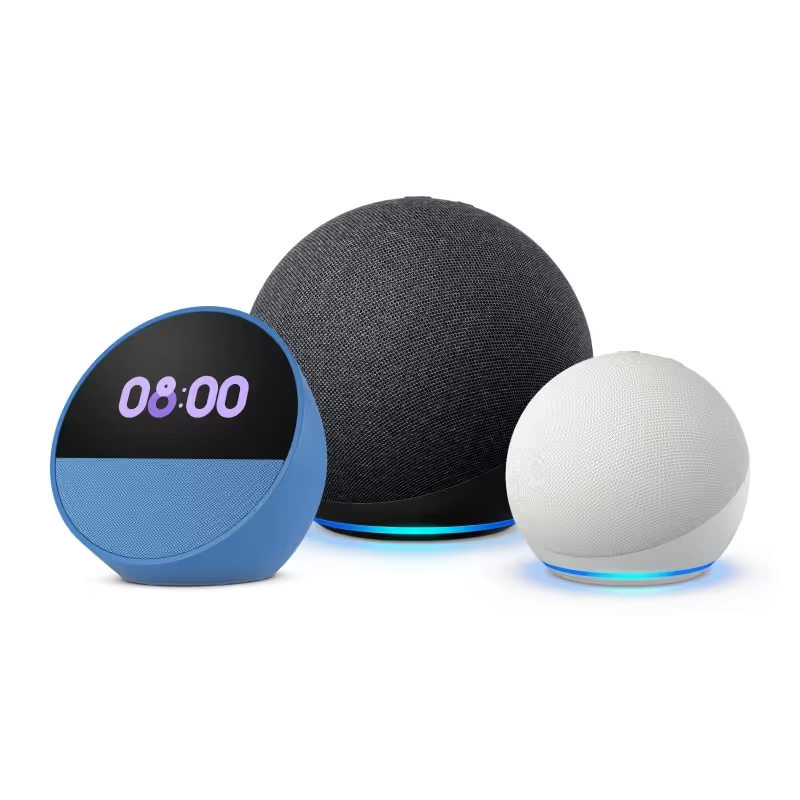
A reader recently sent me a great question: “Should I be worried about my kid using Alexa or Google Home?” It’s a great question, and one I’ve been thinking about more myself lately, especially as these devices become more conversational and, honestly, more human-sounding every day. In today's blog, I dig into the concerns and share practical solutions, including simple replacements for when these devices are used at bedtime.
READ MORE >
We want our kids to be motivated to learn, face challenges, and generate their own ideas. However, school often assigns work that doesn't inspire interest, and now AI provides an easy shortcut. Instead of struggling through it, students can simply ask a chatbot for answers or even complete assignments. In today’s blog, I share five ways parents can help kids stay engaged in learning.
READ MORE >
You might have heard about the tragic suicide of 16‑year‑old Adam Raine, who was talking with ChatGPT for up to four hours a day. His parents filed a wrongful‑death lawsuit against OpenAI and CEO Sam Altman on August 26, 2025, in San Francisco Superior Court. In this blog we talk about the immediate safeguards needed to fix these horrific risks of AI, and offer parents suggestions for how they can talk with their kids about these risks and dealing with strong emotions.
READ MORE >for more like this, DR. DELANEY RUSTON'S NEW BOOK, PARENTING IN THE SCREEN AGE, IS THE DEFINITIVE GUIDE FOR TODAY’S PARENTS. WITH INSIGHTS ON SCREEN TIME FROM RESEARCHERS, INPUT FROM KIDS & TEENS, THIS BOOK IS PACKED WITH SOLUTIONS FOR HOW TO START AND SUSTAIN PRODUCTIVE FAMILY TALKS ABOUT TECHNOLOGY AND IT’S IMPACT ON OUR MENTAL WELLBEING.