


Before I begin, let me say that my heart is raw from aching so much. I send my deepest support to all the families in incomprehensible pain from the latest shooting. Here is something I wrote about helping our kids in these moments of tragedy.
Today is my fifth and final week of writing about mental wellness in honor of Mental Health Awareness Month, 2022.
I know many of us are deeply upset and are doing so much to address issues (donations, rallies, letter writing, and much more). I have also been thinking about the famous oxygen face mask analogy of making sure we do some self-care throughout all of this.
So I asked myself this simple question, “What is the number one thing that has helped me the most day-to-day with my mental wellbeing?” And that is physical movement — call it exercise, call it sports, call it endorphin-releasing activities, call it what you want. It has been life-changing for me and many people I know, including patients I have coached.
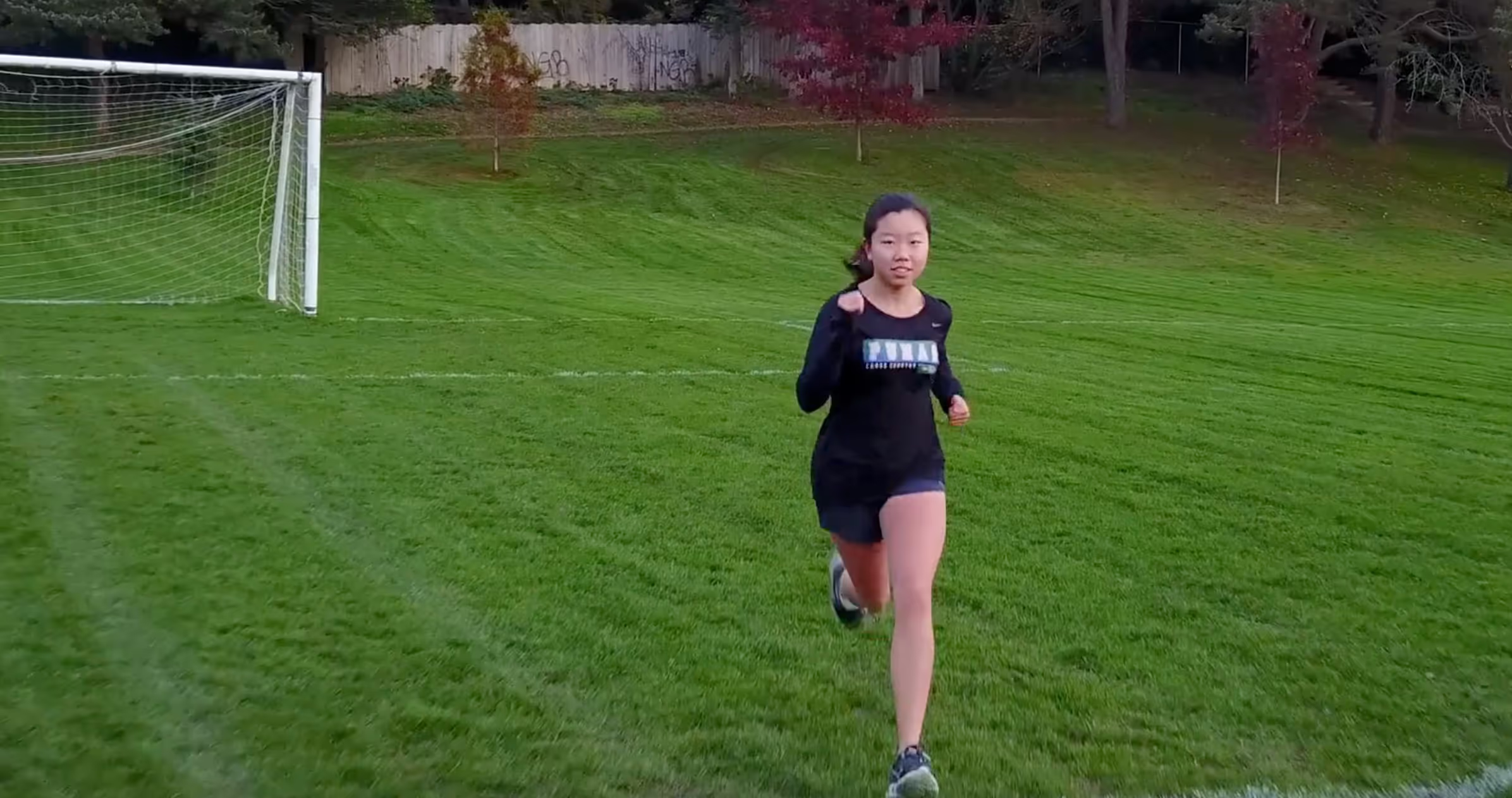
Unfortunately, it was not until right after college that I discovered the power of physical activity on my mental health. Starting then, I began years of running along with other fitness activities. How cool that tomorrow, June 1st, is Global Running Day.
I could not believe that getting my heart rate up could have sustained relaxing effects and consistently lifted my mood. Most importantly, I soon discovered how much it helped me deal with my challenging brain patterns related to times of anxious thoughts that have been in my life since my early twenties.
My repetitive negative thoughts faded into the background during physical activity, which is still the case. What is so great is that as the feelings of things like worry or regret subside, my brain has a surge in positive thoughts and creativity. For example, during my workouts, I often get ideas for films, this blog, presentations, etc.
There have been some particularly intense emotional times when walking helped shift my nervous system from states of near panic to a calmer place.
I feel lucky that I found this helpful tool. Yet I know many people face obstacles to bringing movement into their lives.


Learn more about showing our movies in your school or community!
Join Screenagers filmmaker Delaney Ruston MD for our latest Podcast

Learn more about our Screen-Free Sleep campaign at the website!
Our movie made for parents and educators of younger kids
Learn more about showing our movies in your school or community!
Register your interest in bringing our new movie to your school or community
Obstacles are common. There are many reasons physical activities can be lower than desired in someone’s life. I won’t touch on all of them, but I want to point out socio-economic factors — needing to hold two jobs to make a living wage, and the list goes on.
Screen time can also contribute to low activity. And for us parents, it can be exasperating when our kids and teens resist doing physical activities (rapid finger movements via video gaming or phone use do not count).
Today I draw upon my 25-plus years as a doctor and my personal experiences to offer five tips that can help launch or increase physical fitness for you and/or your children.
Trust in the power of trial. When we get our kids to try some new form of movement, even one tiny thing, it is planting important seeds that can sprout years from now.
Maybe it is doing a 5-minute high-intensity exercise video with you. They complain and say they don’t like it, but that seed is there, and someday they might look for a similar video. Here is a 5-minute video, and you can sweeten the deal by having your kid pick a song to go with it.
Or maybe you get them to do something, and it sticks right away. How about getting your child to try pickleball with you — and promise it will just be 20 minutes. Maybe they like it and want to do it on another day. That worked with my daughter, and now it’s an activity we love to do together.
5-Minutes Max. When I work with patients to add movement into their lives, they are often surprised by my recommendation of just 5 minutes. I explain the science behind why starting with a tiny goal can be much more effective in building a habit than making the common approach of thinking big right off the bat, such as, “I am going to work out at the gym an hour every day.”
I tell people that even if they want to do more after 5 minutes, don’t. I say to bask in the desire to want to do more and remember that feeling for later. My patients have found success with this approach.
Also, I let them know that creating habits is all about positive reinforcements. That is what keeps us doing things (unless we have to for work, school, etc., this is different from habit building). It is important to boost positive feelings whenever you complete your tiny goal. When you feel good that you achieved your goal, that positive feeling gets boosted when you tell someone and then get that feeling of pride. Or maybe you ask your kid if they will give you a 10-second neck massage each time you complete your 5-minute goal for the next week. (You can tell them that a doctor recommended the neck massage, tee hee.)
Learn more about showing our movies in your school or community!
Join Screenagers filmmaker Delaney Ruston MD for our latest Podcast
Learn more about our Screen-Free Sleep campaign at the website!
Our movie made for parents and educators of younger kids
Join Screenagers filmmaker Delaney Ruston MD for our latest Podcast
Register your interest in bringing our new movie to your school or community
Practice missing days. From the get-go, I work with patients to set the goal of not doing exercise every day. They will likely fail if they strive to do it every day, and when we feel defeated, we can spiral into defeating thought patterns like, “Well, I already failed, so why even keep trying.”
Let’s say someone is doing 20 minutes of activity four times a week, and perhaps they get a bad cold and then miss two weeks. It takes real willpower to restart, which is why it takes practice. Practice finding ways to overcome the brain's negative talk to get back to it — and it may mean going back to the original 5 minutes for a while.
Your actions influence them! We can’t control how much our kids move, particularly once they’re teens. Having our kids see us doing activities and talking with them about things like how it helps with our mood penetrates their consciousness.
And if you are struggling to do more, let them in on your struggle and tell them ways you are trying to make a change. For example, research shows that doing physical activity first thing in the morning can be the magic answer for some people to achieve more regular conditioning. Let your kids know this and tell them you will try first thing in the morning — after your coffee or tea, of course.
I often talk with young adults who had no interest in physical health as teens, but suddenly, things changed in college or afterward.
Both my kids are in college now, and both are doing much more physical activity in college than I ever did. Heck, maybe talking about my regret influenced them.
Let science speak. Weave in a talk about the science of exercise sometime this week. This study looked at moderate vs. high-intensity exercise in undergraduates. The researchers had the subjects sleep with electrodes placed on their heads to compare the sleep quality of those that did more intense vs. moderate exercise. The investigators found that people who did higher intensity workouts improved sleep quality and quantity overall. Better sleep goes hand in hand with feeling better the next day — we all know that. ** Note that even moderate exercise is associated with better sleep.

As we’re about to celebrate 10 years of Screenagers, we want to hear what’s been most helpful and what you’d like to see next.
Please click here to share your thoughts with us in our community survey. It only takes 5–10 minutes, and everyone who completes it will be entered to win one of five $50 Amazon vouchers.
Before I begin, let me say that my heart is raw from aching so much. I send my deepest support to all the families in incomprehensible pain from the latest shooting. Here is something I wrote about helping our kids in these moments of tragedy.
Today is my fifth and final week of writing about mental wellness in honor of Mental Health Awareness Month, 2022.
I know many of us are deeply upset and are doing so much to address issues (donations, rallies, letter writing, and much more). I have also been thinking about the famous oxygen face mask analogy of making sure we do some self-care throughout all of this.
So I asked myself this simple question, “What is the number one thing that has helped me the most day-to-day with my mental wellbeing?” And that is physical movement — call it exercise, call it sports, call it endorphin-releasing activities, call it what you want. It has been life-changing for me and many people I know, including patients I have coached.
Unfortunately, it was not until right after college that I discovered the power of physical activity on my mental health. Starting then, I began years of running along with other fitness activities. How cool that tomorrow, June 1st, is Global Running Day.
I could not believe that getting my heart rate up could have sustained relaxing effects and consistently lifted my mood. Most importantly, I soon discovered how much it helped me deal with my challenging brain patterns related to times of anxious thoughts that have been in my life since my early twenties.
My repetitive negative thoughts faded into the background during physical activity, which is still the case. What is so great is that as the feelings of things like worry or regret subside, my brain has a surge in positive thoughts and creativity. For example, during my workouts, I often get ideas for films, this blog, presentations, etc.
There have been some particularly intense emotional times when walking helped shift my nervous system from states of near panic to a calmer place.
I feel lucky that I found this helpful tool. Yet I know many people face obstacles to bringing movement into their lives.
Obstacles are common. There are many reasons physical activities can be lower than desired in someone’s life. I won’t touch on all of them, but I want to point out socio-economic factors — needing to hold two jobs to make a living wage, and the list goes on.
Screen time can also contribute to low activity. And for us parents, it can be exasperating when our kids and teens resist doing physical activities (rapid finger movements via video gaming or phone use do not count).
Today I draw upon my 25-plus years as a doctor and my personal experiences to offer five tips that can help launch or increase physical fitness for you and/or your children.
Trust in the power of trial. When we get our kids to try some new form of movement, even one tiny thing, it is planting important seeds that can sprout years from now.
Maybe it is doing a 5-minute high-intensity exercise video with you. They complain and say they don’t like it, but that seed is there, and someday they might look for a similar video. Here is a 5-minute video, and you can sweeten the deal by having your kid pick a song to go with it.
Or maybe you get them to do something, and it sticks right away. How about getting your child to try pickleball with you — and promise it will just be 20 minutes. Maybe they like it and want to do it on another day. That worked with my daughter, and now it’s an activity we love to do together.
5-Minutes Max. When I work with patients to add movement into their lives, they are often surprised by my recommendation of just 5 minutes. I explain the science behind why starting with a tiny goal can be much more effective in building a habit than making the common approach of thinking big right off the bat, such as, “I am going to work out at the gym an hour every day.”
I tell people that even if they want to do more after 5 minutes, don’t. I say to bask in the desire to want to do more and remember that feeling for later. My patients have found success with this approach.
Also, I let them know that creating habits is all about positive reinforcements. That is what keeps us doing things (unless we have to for work, school, etc., this is different from habit building). It is important to boost positive feelings whenever you complete your tiny goal. When you feel good that you achieved your goal, that positive feeling gets boosted when you tell someone and then get that feeling of pride. Or maybe you ask your kid if they will give you a 10-second neck massage each time you complete your 5-minute goal for the next week. (You can tell them that a doctor recommended the neck massage, tee hee.)
Practice missing days. From the get-go, I work with patients to set the goal of not doing exercise every day. They will likely fail if they strive to do it every day, and when we feel defeated, we can spiral into defeating thought patterns like, “Well, I already failed, so why even keep trying.”
Let’s say someone is doing 20 minutes of activity four times a week, and perhaps they get a bad cold and then miss two weeks. It takes real willpower to restart, which is why it takes practice. Practice finding ways to overcome the brain's negative talk to get back to it — and it may mean going back to the original 5 minutes for a while.
Your actions influence them! We can’t control how much our kids move, particularly once they’re teens. Having our kids see us doing activities and talking with them about things like how it helps with our mood penetrates their consciousness.
And if you are struggling to do more, let them in on your struggle and tell them ways you are trying to make a change. For example, research shows that doing physical activity first thing in the morning can be the magic answer for some people to achieve more regular conditioning. Let your kids know this and tell them you will try first thing in the morning — after your coffee or tea, of course.
I often talk with young adults who had no interest in physical health as teens, but suddenly, things changed in college or afterward.
Both my kids are in college now, and both are doing much more physical activity in college than I ever did. Heck, maybe talking about my regret influenced them.
Let science speak. Weave in a talk about the science of exercise sometime this week. This study looked at moderate vs. high-intensity exercise in undergraduates. The researchers had the subjects sleep with electrodes placed on their heads to compare the sleep quality of those that did more intense vs. moderate exercise. The investigators found that people who did higher intensity workouts improved sleep quality and quantity overall. Better sleep goes hand in hand with feeling better the next day — we all know that. ** Note that even moderate exercise is associated with better sleep.
Sign up here to receive the weekly Tech Talk Tuesdays newsletter from Screenagers filmmaker Delaney Ruston MD.
We respect your privacy.
Before I begin, let me say that my heart is raw from aching so much. I send my deepest support to all the families in incomprehensible pain from the latest shooting. Here is something I wrote about helping our kids in these moments of tragedy.
Today is my fifth and final week of writing about mental wellness in honor of Mental Health Awareness Month, 2022.
I know many of us are deeply upset and are doing so much to address issues (donations, rallies, letter writing, and much more). I have also been thinking about the famous oxygen face mask analogy of making sure we do some self-care throughout all of this.
So I asked myself this simple question, “What is the number one thing that has helped me the most day-to-day with my mental wellbeing?” And that is physical movement — call it exercise, call it sports, call it endorphin-releasing activities, call it what you want. It has been life-changing for me and many people I know, including patients I have coached.
Unfortunately, it was not until right after college that I discovered the power of physical activity on my mental health. Starting then, I began years of running along with other fitness activities. How cool that tomorrow, June 1st, is Global Running Day.
I could not believe that getting my heart rate up could have sustained relaxing effects and consistently lifted my mood. Most importantly, I soon discovered how much it helped me deal with my challenging brain patterns related to times of anxious thoughts that have been in my life since my early twenties.
My repetitive negative thoughts faded into the background during physical activity, which is still the case. What is so great is that as the feelings of things like worry or regret subside, my brain has a surge in positive thoughts and creativity. For example, during my workouts, I often get ideas for films, this blog, presentations, etc.
There have been some particularly intense emotional times when walking helped shift my nervous system from states of near panic to a calmer place.
I feel lucky that I found this helpful tool. Yet I know many people face obstacles to bringing movement into their lives.

Tech journalist Manoush Zomorodi recently shared with Delaney the story behind her new book Body Electric and the citizen science experiment she ran with NPR and Dr. Keith Diaz of Columbia. The 20,000-person study found that five minutes of movement for every thirty minutes of sitting dropped fatigue by up to 28%, lowered blood glucose and blood pressure, and improved focus and mood. Plus, five practical reframes for talking to kids about movement without the eye rolls.
READ MORE >

Catherine Price’s “Rebel's Code” focuses on intentional technology use and prioritizing real-world friendship, freedom, and fun. Her book The Amazing Generation, co-written with Jonathan Haidt, introduces these concepts to children through interactive formats and teen perspectives. Research indicates that when adolescents understand how platforms are designed to exploit attention, they show greater motivation to limit their social media use.
READ MORE >for more like this, DR. DELANEY RUSTON'S NEW BOOK, PARENTING IN THE SCREEN AGE, IS THE DEFINITIVE GUIDE FOR TODAY’S PARENTS. WITH INSIGHTS ON SCREEN TIME FROM RESEARCHERS, INPUT FROM KIDS & TEENS, THIS BOOK IS PACKED WITH SOLUTIONS FOR HOW TO START AND SUSTAIN PRODUCTIVE FAMILY TALKS ABOUT TECHNOLOGY AND IT’S IMPACT ON OUR MENTAL WELLBEING.