

Facebook and Instagram told The Telegraph newspaper earlier this month that they would ban images that promote or glamorize eating disorders, particularly photos that promote self-harm.
The social media giant issued a statement in February saying it had consulted experts about online safety and self-harm. “First, these experts unanimously reaffirmed that Facebook should allow people to share admissions of self-harm and suicidal thoughts, but should not allow people to share content promoting it.”
Teens turn to social media and the Internet for fun things to entertain themselves with, but they also go there when they are struggling emotionally and looking for help. Vulnerable teens are the ones I’m most concerned about; there is plenty of harmful information lurking out there. This is particularly true when it comes to eating disorders.
There are threads on Facebook and its sister platform Instagram that actually encourage girls to lose weight by fasting together, or by emulating the glamorous, stick-thin models who serve as role models. They share photos of their concave stomachs, thigh gaps, and protruding ribs. I was disturbed to learn of the phrase “Thinspiration” -- taking a problematic way of thinking and turning into a positive idea -- clever and sadly so dangerous.
Social feeds known as pro-ana (pro-anorexia) and pro-mia (pro-bulimia) really are concerning. Eating disorders, from mild to life-threatening, impact all ages and genders. There is so much suffering for people dealing with anorexia, bulimia and binge-eating disorder, and so much pain as family members trying to help and often feeling completely lost on what to do.
Jennifer Grygiel, a social media expert and assistant professor of communications at Syracuse University, says those who follow the pro-skinny content on Facebook and Instagram get around the algorithms that weed out disturbing images by using obscure hashtags such as #proana, #skinny or #fasting. Some pages that glamorize eating disorders are private and tell followers to contact them directly to get access.
I was speaking this week with a therapist who specializes in eating disorders and asking what the latest explanatory model that experts are talking about in terms of eating disorders is. There have been times when an anxiety/control model was central, times when an addiction model was the answer, and so on. She said that the latest discussion is about problems with brain pathways and that they see problems in the brain’s reward center. The good news is that many people are doing research in this area and there are many working to get more trained therapists in this line of work—believe me, it is so needed.
For this Tech Talk Tuesday, I want to emphasize how important it is to encourage healthy eating in your home, as well as talking to your teen about what might cause an eating disorder. Though girls are three times as likely to have an eating disorder, it’s important to include your sons in this conversation. Remember, this is a talk that should be done without accusations or blame. You’re curious — and wonder if they are too. The problem is so rampant on Instagram that they have actually created a pretty good resource page in their privacy and safety center on eating disorders.
*We would love for you to share this TTT any way that works for you, whether that’s on social media or via a newsletter. If you want to send it out in your newsletter we just ask that you credit us and link to our website, and let us know at lisa@screenagersmovie.com.
HOST A SCREENING to help spark change.
FIND EVENT LISTINGS
Do you organize professional development in schools? We now have a 6-hour, 3-part training module. Request more information here Professional Development.
Stay in touch with the Screenagers community on Facebook, Twitter and leave comments below.


Learn more about showing our movies in your school or community!
Join Screenagers filmmaker Delaney Ruston MD for our latest Podcast

Learn more about our Screen-Free Sleep campaign at the website!
Our movie made for parents and educators of younger kids
Learn more about showing our movies in your school or community!
Register your interest in bringing our new movie to your school or community
Learn more about showing our movies in your school or community!
Join Screenagers filmmaker Delaney Ruston MD for our latest Podcast
Learn more about our Screen-Free Sleep campaign at the website!
Our movie made for parents and educators of younger kids
Join Screenagers filmmaker Delaney Ruston MD for our latest Podcast
Register your interest in bringing our new movie to your school or community

As we’re about to celebrate 10 years of Screenagers, we want to hear what’s been most helpful and what you’d like to see next.
Please click here to share your thoughts with us in our community survey. It only takes 5–10 minutes, and everyone who completes it will be entered to win one of five $50 Amazon vouchers.
Facebook and Instagram told The Telegraph newspaper earlier this month that they would ban images that promote or glamorize eating disorders, particularly photos that promote self-harm.
The social media giant issued a statement in February saying it had consulted experts about online safety and self-harm. “First, these experts unanimously reaffirmed that Facebook should allow people to share admissions of self-harm and suicidal thoughts, but should not allow people to share content promoting it.”
Teens turn to social media and the Internet for fun things to entertain themselves with, but they also go there when they are struggling emotionally and looking for help. Vulnerable teens are the ones I’m most concerned about; there is plenty of harmful information lurking out there. This is particularly true when it comes to eating disorders.
There are threads on Facebook and its sister platform Instagram that actually encourage girls to lose weight by fasting together, or by emulating the glamorous, stick-thin models who serve as role models. They share photos of their concave stomachs, thigh gaps, and protruding ribs. I was disturbed to learn of the phrase “Thinspiration” -- taking a problematic way of thinking and turning into a positive idea -- clever and sadly so dangerous.
Social feeds known as pro-ana (pro-anorexia) and pro-mia (pro-bulimia) really are concerning. Eating disorders, from mild to life-threatening, impact all ages and genders. There is so much suffering for people dealing with anorexia, bulimia and binge-eating disorder, and so much pain as family members trying to help and often feeling completely lost on what to do.
Jennifer Grygiel, a social media expert and assistant professor of communications at Syracuse University, says those who follow the pro-skinny content on Facebook and Instagram get around the algorithms that weed out disturbing images by using obscure hashtags such as #proana, #skinny or #fasting. Some pages that glamorize eating disorders are private and tell followers to contact them directly to get access.
I was speaking this week with a therapist who specializes in eating disorders and asking what the latest explanatory model that experts are talking about in terms of eating disorders is. There have been times when an anxiety/control model was central, times when an addiction model was the answer, and so on. She said that the latest discussion is about problems with brain pathways and that they see problems in the brain’s reward center. The good news is that many people are doing research in this area and there are many working to get more trained therapists in this line of work—believe me, it is so needed.
For this Tech Talk Tuesday, I want to emphasize how important it is to encourage healthy eating in your home, as well as talking to your teen about what might cause an eating disorder. Though girls are three times as likely to have an eating disorder, it’s important to include your sons in this conversation. Remember, this is a talk that should be done without accusations or blame. You’re curious — and wonder if they are too. The problem is so rampant on Instagram that they have actually created a pretty good resource page in their privacy and safety center on eating disorders.
*We would love for you to share this TTT any way that works for you, whether that’s on social media or via a newsletter. If you want to send it out in your newsletter we just ask that you credit us and link to our website, and let us know at lisa@screenagersmovie.com.
HOST A SCREENING to help spark change.
FIND EVENT LISTINGS
Do you organize professional development in schools? We now have a 6-hour, 3-part training module. Request more information here Professional Development.
Stay in touch with the Screenagers community on Facebook, Twitter and leave comments below.
Sign up here to receive the weekly Tech Talk Tuesdays newsletter from Screenagers filmmaker Delaney Ruston MD.
We respect your privacy.
Facebook and Instagram told The Telegraph newspaper earlier this month that they would ban images that promote or glamorize eating disorders, particularly photos that promote self-harm.
The social media giant issued a statement in February saying it had consulted experts about online safety and self-harm. “First, these experts unanimously reaffirmed that Facebook should allow people to share admissions of self-harm and suicidal thoughts, but should not allow people to share content promoting it.”
Teens turn to social media and the Internet for fun things to entertain themselves with, but they also go there when they are struggling emotionally and looking for help. Vulnerable teens are the ones I’m most concerned about; there is plenty of harmful information lurking out there. This is particularly true when it comes to eating disorders.
There are threads on Facebook and its sister platform Instagram that actually encourage girls to lose weight by fasting together, or by emulating the glamorous, stick-thin models who serve as role models. They share photos of their concave stomachs, thigh gaps, and protruding ribs. I was disturbed to learn of the phrase “Thinspiration” -- taking a problematic way of thinking and turning into a positive idea -- clever and sadly so dangerous.
Social feeds known as pro-ana (pro-anorexia) and pro-mia (pro-bulimia) really are concerning. Eating disorders, from mild to life-threatening, impact all ages and genders. There is so much suffering for people dealing with anorexia, bulimia and binge-eating disorder, and so much pain as family members trying to help and often feeling completely lost on what to do.
Jennifer Grygiel, a social media expert and assistant professor of communications at Syracuse University, says those who follow the pro-skinny content on Facebook and Instagram get around the algorithms that weed out disturbing images by using obscure hashtags such as #proana, #skinny or #fasting. Some pages that glamorize eating disorders are private and tell followers to contact them directly to get access.
I was speaking this week with a therapist who specializes in eating disorders and asking what the latest explanatory model that experts are talking about in terms of eating disorders is. There have been times when an anxiety/control model was central, times when an addiction model was the answer, and so on. She said that the latest discussion is about problems with brain pathways and that they see problems in the brain’s reward center. The good news is that many people are doing research in this area and there are many working to get more trained therapists in this line of work—believe me, it is so needed.
For this Tech Talk Tuesday, I want to emphasize how important it is to encourage healthy eating in your home, as well as talking to your teen about what might cause an eating disorder. Though girls are three times as likely to have an eating disorder, it’s important to include your sons in this conversation. Remember, this is a talk that should be done without accusations or blame. You’re curious — and wonder if they are too. The problem is so rampant on Instagram that they have actually created a pretty good resource page in their privacy and safety center on eating disorders.
*We would love for you to share this TTT any way that works for you, whether that’s on social media or via a newsletter. If you want to send it out in your newsletter we just ask that you credit us and link to our website, and let us know at lisa@screenagersmovie.com.
HOST A SCREENING to help spark change.
FIND EVENT LISTINGS
Do you organize professional development in schools? We now have a 6-hour, 3-part training module. Request more information here Professional Development.
Stay in touch with the Screenagers community on Facebook, Twitter and leave comments below.

The Los Angeles Unified School District, the second-largest in the country, just approved districtwide screen time limits starting in the 2026–27 school year. Students through 1st grade won't use school devices, grades 2–5 will move from 1-to-1 iPads to shared laptop carts, and older students will face screen time limits with YouTube blocked. Devices also won't be allowed during passing periods, lunch, or recess. Credit goes to the parent- and teacher-led group Schools Beyond Screens, whose organizing and advocacy work helped make it happen.
READ MORE >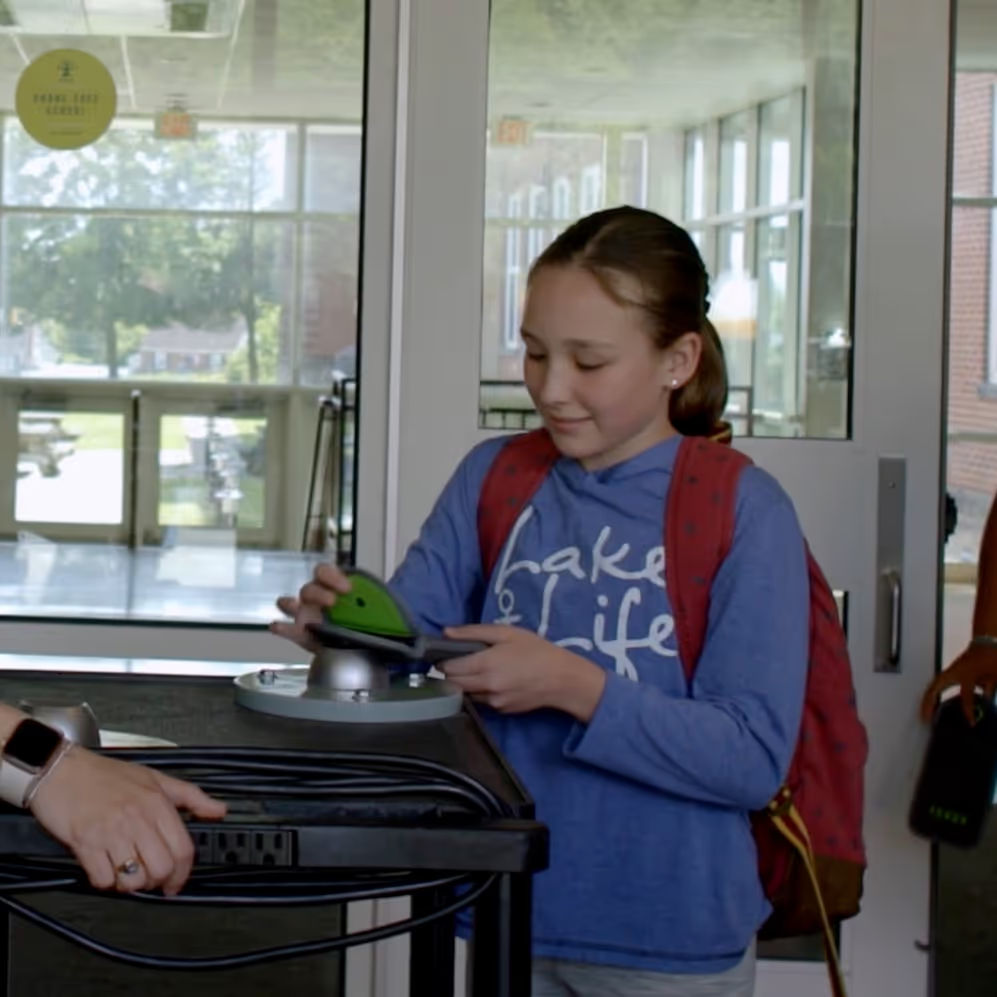
This year, millions of students are experiencing a major shift: school days without phones, smartwatches, or other personal devices. Today we explore the wins, hurdles, and solutions helping schools succeed. We also share our resources that you can use to support technology policy changes in your schools.
READ MORE >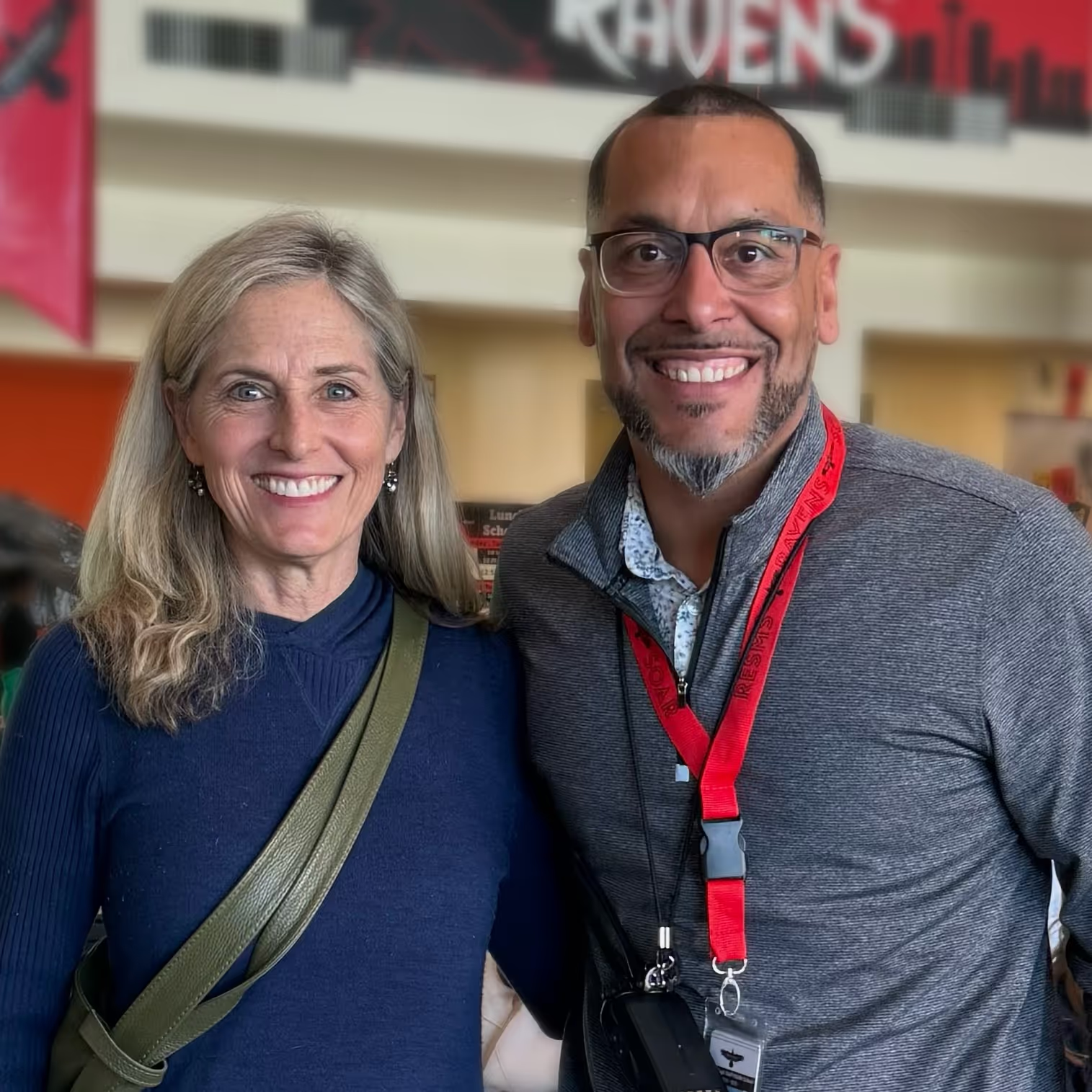
I recently sat down with middle school principal Zach at his school in Washington State. We talked about the challenges Zach and his team faced in his early years as principal when students used phones during school, and how he brought about a powerful transformation by having phones and smartwatches put away in locked pouches for the whole school day. In today’s blog, to raise awareness of the challenges, I share five real examples from Zach of the troubling ways students use phones at school to be unkind.
READ MORE >for more like this, DR. DELANEY RUSTON'S NEW BOOK, PARENTING IN THE SCREEN AGE, IS THE DEFINITIVE GUIDE FOR TODAY’S PARENTS. WITH INSIGHTS ON SCREEN TIME FROM RESEARCHERS, INPUT FROM KIDS & TEENS, THIS BOOK IS PACKED WITH SOLUTIONS FOR HOW TO START AND SUSTAIN PRODUCTIVE FAMILY TALKS ABOUT TECHNOLOGY AND IT’S IMPACT ON OUR MENTAL WELLBEING.